
I started trading on Polymarket back in 2019, when it was still a tiny niche product most people outside of crypto Twitter had never heard of. I watched it grow into the biggest prediction market on the planet.
The new Polymarket US exchange is live, but as of right now, it’s iOS only, fees just went up, and liquidity is still thinner than what you’d find on the international platform (which is geoblocked for US traders).
US prediction markets aren’t going anywhere, but in the meantime, it’s worth knowing what good Polymarket alternatives you have. I spent time digging into the platforms below the same way I’d vet anything before recommending it to a beginner, and here’s what actually stood out.
Top Apps Like Polymarket in October 2026
Not every site like Polymarket floating around online is built the same way. Some are fully regulated US exchanges. Some are play-money practice grounds. A couple are sports-only exchanges wearing a prediction market label.
Here are the best apps like Polymarket that I think are genuinely worth your attention right now.
1. Kalshi

If you want the platform that feels like the most finished, professional product right now, Kalshi is the best Polymarket alternative. It’s a CFTC-regulated exchange, which means it operates under direct federal oversight instead of the patchwork of state-by-state rules that govern most sports betting apps.
You fund your account in US dollars through a bank transfer or card, trade through a clean app or website, and never have to think about a crypto wallet.
The biggest difference between Kalshi and Polymarket comes down to regulation and funding. Polymarket’s international platform runs on USDC and the Polygon blockchain, while Kalshi settles everything in plain dollars under direct CFTC oversight.
Kalshi has also become the default home for sports trading specifically, with sports now making up the large majority of its weekly volume, while Polymarket’s volume is split more evenly across sports, politics, and crypto.
I’d point Kalshi at anyone who wants the regulatory clarity of a fully licensed US exchange and doesn’t want to touch wallets, gas fees, or stablecoins at all.
2. Robinhood

If you already have a Robinhood account for stocks or crypto, this is about as close to friction-free as prediction market trading gets.
Robinhood event contracts live right inside the existing Robinhood app, so there’s no new account to open, and no separate identity check to sit through. Robinhood routes these trades through regulated partner exchanges like Kalshi behind the scenes, which keeps everything under CFTC oversight, even though you never actually see an order book.
The tradeoff compared to Polymarket is depth versus convenience. You’re trading a curated shortlist of popular contracts rather than the full breadth Polymarket offers, there’s no way to place limit orders or check market depth, and Robinhood just shifted its fee structure in June 2026 to a probability-weighted commission that runs noticeably higher on coin-flip contracts priced near 50 cents.
Robinhood is best for someone who wants to dip a toe into event contracts using money that’s already sitting in a brokerage account, not someone trying to actively trade in size.
3. PredictIt
PredictIt has been the home base for politics prediction trading since 2014, and it just went through a genuine regulatory upgrade. After years of operating under a CFTC “no-action letter” that capped individual positions at $850 per contract, PredictIt is now a fully registered Designated Contract Market, and that per-contract cap has been raised to $3,500.
Where PredictIt really differs from Polymarket is focus. There’s no sports, no crypto, no pop culture markets, just elections, nominations, and control-of-government questions, traded in US dollars through a regular bank-linked account.
The fees are also noticeably steeper than what you’ll find on Polymarket or Kalshi: a 10% cut on profits plus a 5% withdrawal fee.
I’d recommend Predictit specifically to political news junkies who want deep, well-established election markets and don’t mind paying a bit more for that focus.
4. Crypto.com Predictions

Crypto.com’s prediction markets run through Crypto.com Derivatives North America, the CFTC-regulated exchange formerly known as Nadex, which gives it one of the longer regulatory track records on this list.
If you’re already using Crypto.com for crypto trading, having prediction markets in the same app is genuinely convenient, and the fee structure is refreshingly simple: a flat fee per contract based on contract value, instead of the variable, formula-based fees you’ll see elsewhere.
Compared to Polymarket, the market selection here is still catching up. You’ll find solid coverage of politics, economics, and finance-related contracts, but it’s a noticeably shorter list than what’s on Polymarket or Kalshi, and sports contract availability has been a moving target because of ongoing state-level legal challenges.
Crypto.com is a strong pick for existing users who want one app for both crypto and event contracts, and a weaker pick for anyone chasing the widest possible market variety.
5. ProphetX

ProphetX just earned its CFTC license to operate as a Designated Contract Market and Derivatives Clearing Organization in June 2026, capping off a multi-year shift away from the sweepstakes model it originally launched with.
It’s a peer-to-peer exchange built specifically for sports, which means you’re trading against other users at prices the market sets, not accepting odds a sportsbook decided on for you. The fee structure is one of the more trader-friendly ones I’ve come across: roughly 2% to 3% on net winnings only, with nothing charged on losing trades.
Polymarket spreads its liquidity across politics, cryptocurrencies, and global events alongside sports, while ProphetX is sports and only sports, covering the major US leagues plus a rotating slate of soccer and college markets.
If you came to prediction markets mainly for game outcomes and player props and couldn’t care less about trading on the Fed or the next election, ProphetX’s exchange-style pricing is worth a look, especially next to a traditional sportsbook’s built-in margin.
6. Manifold Markets

Manifold takes a completely different approach than the other platforms. It’s a play-money platform, trading in a virtual currency called Mana instead of real cash.
After winding down its real-money sweepstakes program back in 2025, Manifold settled into being a pure forecasting playground, where literally any user can create a market on almost any question. There’s no identity verification, no funding method to set up, and zero trading fees.
Obviously, the biggest difference from Polymarket is that nothing on Manifold has financial stakes attached. Your account balance is a score, not a bankroll. What you get in exchange is an enormous, constantly growing library of markets on topics you’d genuinely never find on a regulated exchange, plus a public calibration record that tracks how accurate your predictions actually are over time.
I point a lot of beginners to Manifold first. It’s the cheapest way I know of to learn how prediction markets actually move before you put a single real dollar on the line.
7. Metaculus
Metaculus isn’t a trading platform at all; it’s a forecasting platform, and I’m including it because it scratches a very similar itch to Polymarket without any of the market mechanics.
Instead of buying and selling contracts, you submit a probability estimate on a question, and your accuracy gets scored against the actual outcome using proper statistical scoring rules. It’s completely free, and it’s used seriously by research institutions and policy groups, not just hobbyists.
Where Metaculus pulls away from Polymarket is the kind of question it can ask. Because nobody’s capital is tied up in a contract, Metaculus can run questions that take years to resolve, things like AI development timelines or long-range climate benchmarks, that a real-money exchange simply can’t support economically.
If you’re the type who reads about superforecasters and cares more about being well-calibrated than about making money, Metaculus is genuinely one of the best places on the internet to build that skill.
Polymarket vs Competitors Overview
Here’s how all of these stack up side by side on the details that actually matter when you’re choosing a platform.
| Platform | Regulation | Currency | Trading Fee | Market Categories | Best For |
| Polymarket | Unregulated intl. (geoblocked in US) / CFTC-regulated US exchange | USDC (intl.) / USD (US) | Mostly fee-free intl; 5% taker fee (US) | Politics, sports, crypto, geopolitics, culture | Crypto-native traders wanting the deepest liquidity |
| Kalshi | CFTC-regulated DCM | USD | Variable taker fee (~1-3% typical) | Sports, politics, economics, weather, crypto | All-around US traders wanting full regulation |
| Robinhood Event Contracts | CFTC-regulated (via Robinhood Derivatives LLC) | USD | ~$0.01-0.02/contract, moving to 5-10% of expected value | Sports, politics, economics, entertainment | Existing Robinhood users wanting simple onboarding |
| PredictIt | CFTC-regulated DCM | USD | 10% fee on profits + 5% withdrawal fee | US politics and elections only | Political junkies wanting deep election markets |
| Crypto.com Prediction Trading | CFTC-regulated (Crypto.com Derivatives North America) | USD | Flat fee per contract, scaled to value | Politics, economics, finance (expanding) | Crypto.com users wanting one app for both |
| ProphetX | CFTC-regulated DCM/DCO | USD | ~2-3% fee on net winnings only | Sports only | Sports bettors wanting exchange-style pricing |
| Manifold Markets | Unregulated, play-money | Mana (no cash value) | $0 | Politics, tech, sports, culture, anything users create | Beginners wanting zero-risk practice |
| Metaculus | Not a financial exchange | None (points-based) | Free | Geopolitics, science, tech, AI, long-horizon questions | Forecasting fans who value calibration over cash |
*Fees, regulation, and availability in this space change often, so treat this table as a snapshot rather than gospel and double-check current terms directly on each platform before funding an account.
How Prediction Markets Like Polymarket Work
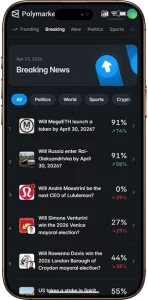
Every market on these platforms is built around a clear, dated question, something like whether the Fed will cut rates at its next meeting.
The contract for “yes” trades somewhere between 1 cent and 99 cents, and that price is the market’s running estimate of the probability the answer is yes. A contract sitting at 65 cents implies the crowd thinks there’s roughly a 65% chance the event happens, and that price shifts continuously as news breaks and people trade on it.
When the event finally resolves, every “yes” contract pays out exactly $1 if the answer was yes, and $0 if it wasn’t, with the reverse true for “no” contracts. Your profit or loss depends on what you paid relative to that $1 ceiling, not on simply guessing correctly in some abstract sense.
This is the part that trips up a lot of beginners, myself included. I got badly burned on a political market back in 2022 that I was sure was a near lock at 78 cents, added more to the position, and watched it resolve against me.
By the time something feels obvious, the price has usually already priced in most of that obviousness, so there’s a lot less upside left than it looks like from the outside.
Are Sites Like Polymarket Safe and Legal?
It depends entirely on which platform, and which version of that platform, you mean. Polymarket itself is a good example of why this gets confusing, because there are genuinely two separate products wearing the same name.
The international Polymarket exchange runs on crypto rails and has been geoblocked for US IP addresses since a 2022 CFTC settlement, while Polymarket US is a newer, separate CFTC-regulated exchange that’s legal for US residents, though right now it’s only available on iOS with Android and desktop still pending.
The other sites like Polymarket on this list sit on a similar spectrum:
- Kalshi, Robinhood, PredictIt, Crypto.com, and ProphetX are all registered, CFTC-regulated exchanges, which gives you federal-level oversight and protections like segregated client funds.
- Manifold and Metaculus sidestep most of that regulation entirely because no real money changes hands on their core product.
That said, the legal picture around sports-related event contracts specifically is still being fought out in court between the CFTC and several state regulators, and access can shift depending on where you live.
My recommendation: Always check a platform’s current state-availability page before depositing any funds, since this is one corner of the industry where the rules are genuinely still moving.
Which Polymarket Alternative is Better for Me?
There’s no single “best” pick here, it really comes down to what you’re trying to get out of it. Use this as a quick gut check:
- Total beginner who wants zero financial risk while learning the mechanics: Manifold Markets, or Metaculus if you care more about calibration than a fun, social feed.
- Want full US regulation without touching crypto or a wallet: Kalshi.
- Already have a Robinhood account and want the path of least resistance: Robinhood Event Contracts.
- Specifically obsessed with US elections and political outcomes: PredictIt.
- Already using Crypto.com and want predictions in the same app: Crypto.com Prediction Trading.
- Mainly want to trade game outcomes and player props, not politics or crypto: ProphetX, Novig, Fanatics Markets.
- Want the deepest liquidity and the widest global market list, and don’t mind a crypto wallet: Polymarket’s international exchange, where it’s legally accessible, or Polymarket US as it builds out further.
Whichever one you land on, treat your first few weeks as tuition rather than profit. That’s true on Polymarket, and it’s true on every single platform on this list.
