
Pariflow is a crypto-funded prediction market built for people who want global event coverage. It runs on Polygon, settles in USDC.e, and lists everything from US presidential nominations to leadership changes in Ethiopia and Venezuela.
My Pariflow review covers everything from available markets to legality, welcome promos, and strategies to make the most out of it.
A lot holds up with this emerging platform. There is a real order book with limit orders, a demo mode that most competitors do not bother building, a full documentation site, and a legal center that publishes market rules and an execution error policy. What I didn’t love was the fee disclosure, and I’ll talk about that down below.
Pariflow Welcome Bonus
Pariflow runs a 100% first deposit match, capped at $50, and it applies automatically after your first completed deposit. There is no Pariflow promo code needed.
Having a welcome bonus is a major differentiator, since most prediction market apps don’t have one.
The terms of Pariflow’s bonus:
| Term | How it works |
|---|---|
| Bonus type | First deposit match |
| Match rate | 100% of your first net deposit |
| Maximum bonus | $50 |
| Eligibility | One per account, first completed deposit only |
| Activation | Automatic, no promo code or manual claim |
| Playthrough | 2x the bonus amount in trading volume |
| Withdrawals during playthrough | Locked until playthrough is complete |
| Bonus principal | Not withdrawable |
| Withdrawable after unlock | Your deposit and your trading profits |
How the Pariflow promo works
The cap is the part people get wrong, so let me be concrete.
| Your first deposit | Bonus you get | Trading balance | Playthrough required |
|---|---|---|---|
| $20 | $20 | $40 | $40 in volume |
| $50 | $50 | $100 | $100 in volume |
| $100 | $50 | $150 | $100 in volume |
Notice what happens at $100. You deposit twice as much, and the bonus does not move because it is capped at $50.
The efficient deposit for bonus purposes is exactly $50. Anything above that is a decision about your own trading plan, not about the promo.
Playthrough requirement
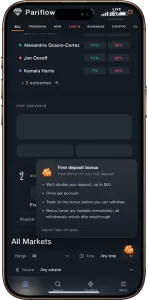
Playthrough is 2x the bonus, not 2x your deposit. A $50 bonus means $100 of qualifying trading volume before withdrawals unlock. That is modest by industry standards, and I want to give credit where it is due.
Sportsbook bonuses routinely bury 20x or 30x requirements in the fine print. A 2x volume requirement sits at the friendly end of the spectrum.
But two things are non-negotiable, and you need to internalize them before you fund anything:
- Withdrawals are locked while playthrough is active. If you deposit, change your mind, and want your money back tomorrow, you cannot simply take it. You have to trade through first.
- The bonus principal is not withdrawable. It is trading credit, not cash. After playthrough, your deposit and your profits come out. The $50 gift itself does not.
It is one of the cleaner bonus structures I have looked at in this category, and Pariflow deserves credit for publishing the terms openly instead of burying them.
Is Pariflow Legit?
Legit in the sense of “this is a real, functioning product with real money moving through it”? Yes, and more convincingly than I expected going in.
The top political markets carry seven-figure volume and comment threads running into the thousands, and major sporting events get hundreds of individual markets.
Behind the product sits a full documentation site covering market mechanics, market states, resolution, order execution, and API access, plus a legal center with terms, market rules, an execution error policy, jurisdiction eligibility rules, regulatory disclosures, and a standalone risk warning.
Demo mode is there. There is two-factor authentication. There is an explicit, deliberately friction-heavy account deletion flow. Platforms running a scam do not typically build an execution error policy and a glossary.
The small handful of Trustpilot reviewers who mentioned withdrawals reported completing them without issue, which is a tiny sample but points the right way on the only question that ultimately matters.
Is Pariflow Safe?
Safe in the sense of “regulated, licensed, and backed by protections if something goes wrong”? No, and this is the part I want you to sit with.
Public disclosures do not show Pariflow holding a CFTC Designated Contract Market license or an equivalent registration with any major Western regulator.
That is the exact opposite of Kalshi, a licensed DCM, and it means the consumer protections you get on a regulated exchange are simply not present here.
The risks are structural: smart contract exploits, resolution disputes with no appeals process above the platform’s own rules, sudden loss of access if a regulator moves against the site, and the ordinary one you already know about, where a losing binary contract goes to zero.
My rule after seven years in this space: on an unregulated venue, only risk what you would be genuinely fine losing, and do not park a balance there between trades.
Where Is Pariflow Prediction Market Legal?
Pariflow is built as a global platform rather than a US-regulated one, and it is upfront about what that means.
The terms state that users must be at least 18, or the age of majority in their jurisdiction, whichever is higher, and that users themselves are responsible for determining whether their use is lawful where they live.
Access may be restricted or prohibited based on law, regulation, sanctions, licensing scope, or Pariflow’s own policy. There is a dedicated jurisdiction eligibility page in the legal center, which is more than many crypto-native venues bother with, but the compliance burden still lands on you.
Pariflow App & Mobile Experience Review
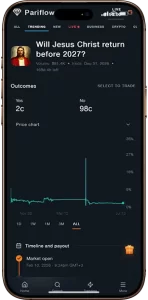
There is no native Pariflow app in the iOS App Store or Google Play.
What Pariflow ships is a progressive web app. Dig into the site’s metadata and the full PWA configuration is there: an app-capable flag, a defined app title, a status bar style, a theme color.
In plain English, you open pariflow.com in Safari or Chrome on your phone, add it to your home screen, and it launches full-screen with no browser chrome. It looks and behaves like a native app.
This is not unusual, and it is not a knock on Pariflow specifically. Polymarket does the same thing. Most prediction markets do, because Apple and Google’s review policies around anything resembling gambling or derivatives make native approval genuinely difficult for platforms without a regulator’s stamp.
What stands out to me about the mobile build:
- The market board is designed for thumb-scrolling, the category strip (Trending, New, Live, Politics, Crypto, Economy, and the rest) sits right at the top, and each market card surfaces volume, comment count, and time remaining without you needing to tap in.
- Tournament sections are split into Games, Props, and Bracket tabs, which is a smart layout for event trading on a small screen.
The verdict on mobile: the interface is clean and it is not a downgrade from desktop. But if you rely on push notifications to catch a fast-moving market, this is not the platform for you. Set your alerts elsewhere.
Markets You Can Trade on Pariflow Predictions

Pariflow organizes everything into a persistent category strip: Business, Crypto, Culture, Economy, Elections, Finance, Politics, Science, Tech, and World, plus Trending, New, and Live filters and a dedicated sports section.
Politics and Elections
Unambiguously where Pariflow’s liquidity lives, by a wide margin. Long-dated US nomination markets are the anchor, with the top one carrying around $2.0 million in volume and over 1,200 comments when I looked. International elections sit behind them in the low-to-mid six figures.
The structural detail worth learning from is the ratio between related markets. The 2028 Democratic nomination market was running roughly four times the volume of the Republican one. It tells you where the genuine disagreement is, which is exactly what a prediction market is supposed to tell you.
Sports and Esports
Pariflow builds dedicated sports prediction market hubs for major tournaments, one of the more thoughtful parts of the product. Each hub splits into Games, Props, and Bracket tabs, which is a useful structure.
You can trade individual fixtures, player and event props, or the tournament outcome, without wading through one undifferentiated list.
Geopolitics and World Events
Pariflow’s most distinctive category and, in my view, its most interesting. This is where you find leadership and conflict markets on countries most platforms simply will not list: Ethiopia, Venezuela, Brazil, Israel, Iran. Volumes here sat in the mid-five figures to high six figures.
Six figures of volume in the Ethiopian leadership market is not something you find anywhere else. If you follow international politics closely and have never found a good way to monetize that, this category alone justifies opening an account.
Economy and Finance
Economy prediction markets are smaller but consistently present. Central bank decision markets, inflation prints, and crypto price milestones are standing fixtures that relist as each event cycle comes around.
Depth here is workable but noticeably thinner than the political board, typically running in the tens of thousands rather than the millions.
Culture, Science, and Tech
Culture prediction markets tend to be where you learn what a platform is willing to list.
Pariflow carries near-certainty novelty markets (the kind priced at 2% Yes and 98% No) that attract five-figure volume from traders who enjoy collecting near-certain pennies.
Pro tip: Before you decide that it is free money, work out the annualized return on a 98-cent position that does not resolve for another year. It rarely justifies the capital lockup, and that lesson is cheaper to learn on someone else’s account.
Pariflow Trading Features & Tools
What is actually there, described plainly rather than dressed up:
Pariflow Demo Mode
The feature I would tell a beginner to use first, and the one Pariflow undersells. You can trade the full lifecycle with no financial exposure, practice reading spreads, watch P&L move, and learn how a market settles. Most prediction markets do not offer this at all. It is a true differentiator.
Standard Features Worth Mentioning
A real order book with limit and market orders. The documentation covers order execution in detail, including what happens when an order is accepted, rejected, filled, or shown as unavailable. That matters more than beginners realize. A market order takes whatever price is available now. A limit order lets you set your price and wait. On a platform with uneven liquidity, that difference is the gap between a good fill and a bad one.
Sell-before-settlement. You can exit a position before the event resolves. Standard on real exchanges, absent on some newer ones, so worth confirming it exists here. It means you can take profit on a news-driven move without waiting months.
A full calculator suite. Pariflow publishes fee, expected value, Kelly position sizing, slippage impact, break-even probability, and arbitrage net edge calculators. As a numbers guy I will say plainly: these are good, and the Kelly and break-even tools in particular are the ones most retail traders never touch and most need.
Public leaderboard. Ranks traders by profit and volume. I find leaderboards useful for calibration rather than copying. Someone consistently profitable across many resolved markets is signal. Someone on top after one lucky political market is noise. Learning to tell the difference is a skill in itself.
Comment threads. A live discussion layer on each market, which is rare outside Polymarket, and dense enough on the top markets to repay a scroll. Treat it as sentiment, not research.
Granular market filters. Range, time-to-resolution, and volume. The volume filter is the one I would actually use, because it screens out thin markets where the spread will eat you.
Developer access. There is an API with authentication and market data endpoints, plus an agent MCP and CLI. If you build, that is there.
One caveat. Some third-party writeups describe an AI “market assistant” and social copy-trading on Pariflow. I could not confirm either on the live product, and I am not going to describe a tool I could not put my hands on.
Pariflow Trading Strategies & Tips
Here are a few Pariflow trading tips I think will help you based on my experience with the platform.
1. Clear your bonus playthrough in the deepest books available
Your $50 bonus comes with a $100 volume requirement, and here is the trap: forcing volume through a thin market can cost you more than the bonus is worth.
Buy into a low-volume district race with a 4-cent spread and you are paying real money the instant you enter, before you have been right or wrong about anything.
Clear playthrough where liquidity is deepest instead, which on Pariflow means the flagship political markets and whatever major tournament hub is currently live.
Trade markets you would have traded anyway, in places where the spread is narrow, and let playthrough clear as a byproduct. Never the reverse.
2. Use demo mode before you touch the geopolitics board
Pariflow’s international leadership markets are where the platform’s real edge lives, because you are competing against a far smaller and less specialized pool than you would face on a US presidential market. But they are also thin, and resolution can get ambiguous fast.
“Out of power” can mean several different things depending on how the contract is worded. This is exactly what demo mode is for.
Run a few positions there with no money down, read the resolution criteria word for word, and see whether your read on the event survives contact with the actual contract language.
Ambiguous resolution wording is where prediction market disputes are born, and finding that out for free beats finding it out for $200.
3. Use limit orders always, because the spread is the only cost you control
Pariflow supports both order types. On a venue where the fee schedule is not published (more on that below), the one cost you can definitely control is the spread you pay, and a limit order controls it.
Set your price and let the market come to you. When I got badly burned on a US political market in 2022, back when PredictIt was about the only place a US trader could touch one, my thesis was not wrong on day one.
I kept adding at whatever price was showing, and my average entry drifted somewhere I never consciously chose. Discipline on entry price is most of the game, and almost nobody treats it that way.
Deposits & Withdrawals at Pariflow
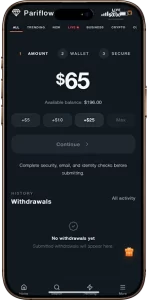
Pariflow funds through crypto. You create an account and fund it with a supported Polygon token, and deposits are auto-swapped to USDC.e.
That auto-swap is a nice touch because you do not need to source the exact right stablecoin yourself.
| Method | Deposit | Withdrawal | Processing Time | Fee | Minimum |
|---|---|---|---|---|---|
| Supported Polygon tokens (auto-swapped to USDC.e) | Yes | Yes | Polygon settles in seconds to minutes under normal conditions | Network gas applies; any platform fee not published, verify in-app | Not published, verify in-app |
| USDC.e on Polygon (direct) | Yes | Yes | Same as above | Network gas applies | Not published, verify in-app |
| Card or fiat on-ramp | Not confirmed on the live product | Not confirmed | N/A | N/A | N/A |
| Bank transfer / ACH | Not available (crypto-funded platform) | Not available | N/A | N/A | N/A |
Two things that matter practically:
- You need to already hold crypto, or be willing to buy it on an exchange and move it to Polygon, before you can trade here. If “bridge it to Polygon” made you tense up, this platform will be a friction wall, and a venue with direct bank funding will serve you better. There is no fiat off-ramp inside Pariflow that I could verify, so getting money back to your bank means routing USDC.e through an exchange yourself.
- The bonus changes your withdrawal picture. If you took the automatic first deposit match, withdrawals are locked until you clear the 2x playthrough. Deposit accordingly. Do not send money you might need back next week.
Pariflow Trading Fees & Costs
This is the one section where I have to be blunt, because it is the platform’s single real transparency failure, and it is worth naming.
Pariflow does not publish a fee schedule anywhere I could find. Not on the site. Not in the FAQ answers accessible outside the app. And not in its documentation, which is otherwise thorough.
The section at docs.pariflow.com covers market mechanics, market states, resolution, order execution, demo trading, API authentication, a glossary, and responsible trading. There is no fees page in any of them.
It gets stranger. Pariflow publishes an excellent Prediction Market Fee Calculator, and the built-in presets are Polymarket and Kalshi. There is no Pariflow preset. The platform’s own beginner guide even tells readers to “check the fee page” without linking to one. A venue that will happily document its execution error policy but not its own trading costs is making a choice, and I do not think it is a good one.
Third-party reviews float a settlement fee “often ranging from 1% to 2% of profits,” but that source hedges every word, cites nothing, and describes platform features the live product does not have. I am not going to put that number in a table and pretend it is a fact.
Here’s how Pariflow costs need to be looked at:
| Cost Type | When It Applies | What I Could Verify |
|---|---|---|
| Platform trading fee | On trades and/or at settlement | Not published. Not on site, not in docs. Verify in-app before your first trade. |
| Settlement fee on winnings | When a market resolves your way | Not published. Third-party figures exist but are unsourced and unreliable. |
| Blockchain gas fee | Deposits, withdrawals, on-chain actions | Real, but Polygon gas is typically a fraction of a cent. A rounding error at retail size. |
| Bid-ask spread | Every single trade | Your biggest real cost, and nobody advertises it. Wide on thin markets, tight on the flagship books. |
| Slippage | Larger orders in thin books | Material outside the top tier. Use limit orders. |
My number-geek point I want to leave you with: traders obsess over the headline fee and ignore the spread, and the spread is almost always the bigger line item. If a platform charges 1% on settlement but you paid a 4-cent spread on a 50-cent contract, the spread cost you eight times what the fee did.
Pariflow Trading Limits & Liquidity
Pariflow’s help documentation includes entries on trading limits and withdrawal limits, so limits exist. The specific numbers are not public, which means you find out when you go to place a trade.
For most retail-sized positions, this will be a non-issue, but if you plan to move size, confirm the ceiling before building a thesis around it.
Liquidity is the more important story, and it is a story of extremes. The top of the board is deep. Flagship political markets in the millions and major tournament hubs in the millions represent real, tradeable liquidity where you can enter and exit at sensible prices. The bottom of the board is thin, and I mean thin.
A district race carrying $50K in volume and one comment is not something you can size into without moving the price against yourself. This is the defining structural characteristic of every prediction market at this stage of growth, Polymarket included in its early years.
What it means for you is that the platform is only as good as the specific market you are trading. Evaluate liquidity market by market rather than assuming the whole venue is deep because the headline numbers look impressive. Check the order book. Check the comment count as a proxy for participation. Then decide your size.
My Experience Testing Pariflow’s Customer Support

Pariflow’s support setup is broader than it first appears. There is a structured FAQ organized into eight categories, a guided product tour, a direct contact-support path, and a dedicated bug reporting flow.
Behind that sits docs.pariflow.com, a proper documentation site covering market mechanics, market states, resolution, order execution, API access, and a plain-language glossary.
There is also a community layer with Discord, Telegram, X, and Instagram, all linked from the platform footer. For a venue at this stage, that is a respectable stack, and the Discord in particular is usually where you get the fastest real answer on a crypto-native platform.
Responsible Trading at Pariflow Prediction Market
Pariflow does more than most crypto-native platforms when it comes to responsible trading.
There is a published responsible trading policy, a standalone risk warning page, and a demo mode that lets you learn pricing, spreads, and P&L without financial exposure, which is the single most useful beginner safeguard a prediction market can offer, and one most competitors simply do not have.
There is a published trading checklist that tells you, in the platform’s own words, to only trade with funds you can afford to lose, to read the market rules and resolution source before entering, to check spread and liquidity rather than trusting the displayed midpoint, and to stop if trading starts to feel compulsive or financially disruptive.
However…
What is not there, and you should know it, is no deposit limits, no loss limits, no cooling-off periods, no session timers, and no self-exclusion tools that I could find documented.
Those are the standard guardrails on regulated gambling and trading platforms, and their absence means you have to build your own. So build them.
Pariflow vs Other Prediction Markets
Pariflow vs Kalshi
The cleanest contrast in the review, because the two are solving opposite problems. Kalshi is a CFTC-regulated Designated Contract Market.
It settles in US dollars, funds through ACH and debit card, has native iOS and Android apps, publishes its fee schedule openly, and gives you the protections of a licensed exchange. Pariflow has none of that. It funds through Polygon crypto, ships a PWA, does not publish fees, and holds no equivalent license I could find.
What Pariflow offers that Kalshi does not is global access, a genuinely unusual geopolitics board, and a demo mode. Kalshi restricts access by country and residency. Pariflow puts leadership markets for countries like Ethiopia and Venezuela in front of anyone who can reach the site.
If you are a US trader who wants regulatory certainty, Kalshi is the better platform, and the gap is not subtle. If you are outside the US, or you want international markets Kalshi will never list, Pariflow becomes worth considering with the risk understood.
- Recommended: See other sites and apps like Kalshi.
Pariflow vs Polymarket
Structurally similar cousins. Both Polygon-based, both settle in USDC, both offer PWAs, both have order books and comment threads. The difference is scale and maturity.
Polymarket runs the deepest order books in the industry, has processed volume in the billions, publishes detailed fee documentation, and has a CFTC-licensed pathway for US users. Pariflow’s flagship markets are respectable for its stage but sit in a different weight class.
So why use Pariflow instead? Three reasons.
Market selection, where the tournament hub structure and the international leadership markets carve out a real niche.
Demo mode, which Polymarket does not offer.
And the counterintuitive one: thinner markets can mean more mispricing. Polymarket’s political prices are efficient because thousands of sharp traders have already picked them over. A mid-six-figure Ethiopian leadership market has not been. That cuts both ways, since wider spreads eat whatever edge you find. But if you genuinely know something about a niche international event, Pariflow gives you somewhere to express it.
- Recommended: Learn more about Polymarket alternatives.
Pariflow vs PredictIt
Nearly Pariflow’s mirror image. PredictIt is US-focused, dollar-funded, long-established, and famously constrained.
It has historically capped how much any single trader can put into a market, which stops whales from skewing prices but also caps your upside and creates a different market dynamic. Pariflow has no such caps that I could find, funds in crypto, and lists global events PredictIt would never touch.
PredictIt also charges 10% on profits plus 5% on withdrawals, which is transparent but expensive. Pariflow’s costs are almost certainly cheaper, but you cannot verify that from the outside, which is its own kind of problem.
PredictIt is where you go for deep, well-worn US political markets with a long track record and published (if steep) costs. Pariflow is where you go for variety, international events, and tournament sports.
My Final Words on Pariflow
Pariflow surprised me. I went in expecting another thinly documented crypto venue and came out looking at a platform with a solid offer.
The political board has genuine depth. The tournament hub structure, with separate Games, Props, and Bracket tabs, is thoughtful product work that holds up event after event. The geopolitics markets are hard to find anywhere else, and if international politics is your area of knowledge, that alone is a reason to open an account.
The $50 automatic first deposit match with only a 2x playthrough is, by the standards of this industry, a fair offer.
That said, Pariflow is not regulated by the CFTC or any equivalent body I could find. It does not publish its fee schedule, not even in its own otherwise-thorough documentation. It offers no deposit limits, loss limits, or self-exclusion tools. It requires crypto funding on Polygon. And if you take the bonus, your withdrawals are locked until you trade through it.
Individually, each of those limitations is manageable. Together, they draw a clear line:
If you are an experienced trader, comfortable with self-custody and crypto rails, who wants international markets you cannot get elsewhere, and who understands that on an unregulated venue you carry the counterparty risk yourself, Pariflow is worth a small, deliberate allocation.
If you are a beginner, if you want a regulator standing behind your money, or if bridging to Polygon makes you nervous, start on Kalshi and come back later. Use demo mode first. Read the in-app fee disclosures before your first real trade. Deposit small, and let the platform earn your trust with a completed withdrawal before you scale.
That is the advice I would give my closest friend, and it is the advice I wish someone had given me in 2019 when I got started with the early versions of prediction markets.
Pariflow Trading FAQs
No, and you do not need one. Pariflow runs a 100% first deposit match up to $50 that applies automatically after your first completed deposit. There is no code, no claim button, and no referral link required. Any site selling you a “Pariflow bonus code” is selling something that does not exist. Promotions can change, so confirm the current offer in-app.
Two things. The bonus carries a 2x playthrough, so a $50 bonus requires $100 in qualifying trading volume, and withdrawals are locked until you clear it. The bonus principal itself is also not withdrawable. After playthrough, you can withdraw your deposit and your profits, but not the $50 gift. The efficient first deposit is exactly $50, since the match is capped there.
Not by the CFTC or any equivalent major regulator, based on public disclosures. This is the biggest structural difference between Pariflow and a licensed venue like Kalshi, and it means you carry the platform risk yourself. Only trade money you are fully prepared to lose.
It does not say. Pariflow publishes a full documentation site with no fee page, and its own fee calculator has presets for Polymarket and Kalshi but none for itself. Polygon gas fees are negligible. Check the in-app fee disclosures before your first trade, and remember the bid-ask spread is usually a bigger real cost than any headline fee.
Yes. Pariflow offers a demo mode where you can trade the full lifecycle with no financial exposure. Most prediction markets do not offer this. If you are new, use it before you fund anything.
Prediction markets involve real financial risk. A losing binary position results in the complete loss of the capital committed to it. Nothing in this review is financial advice, and no platform detail here should be treated as permanent. Fees, bonus terms, market availability, funding methods, limits, and legal access can change at any time and differ by jurisdiction. Always verify current terms on the platform and confirm the rules that apply where you live before trading.
