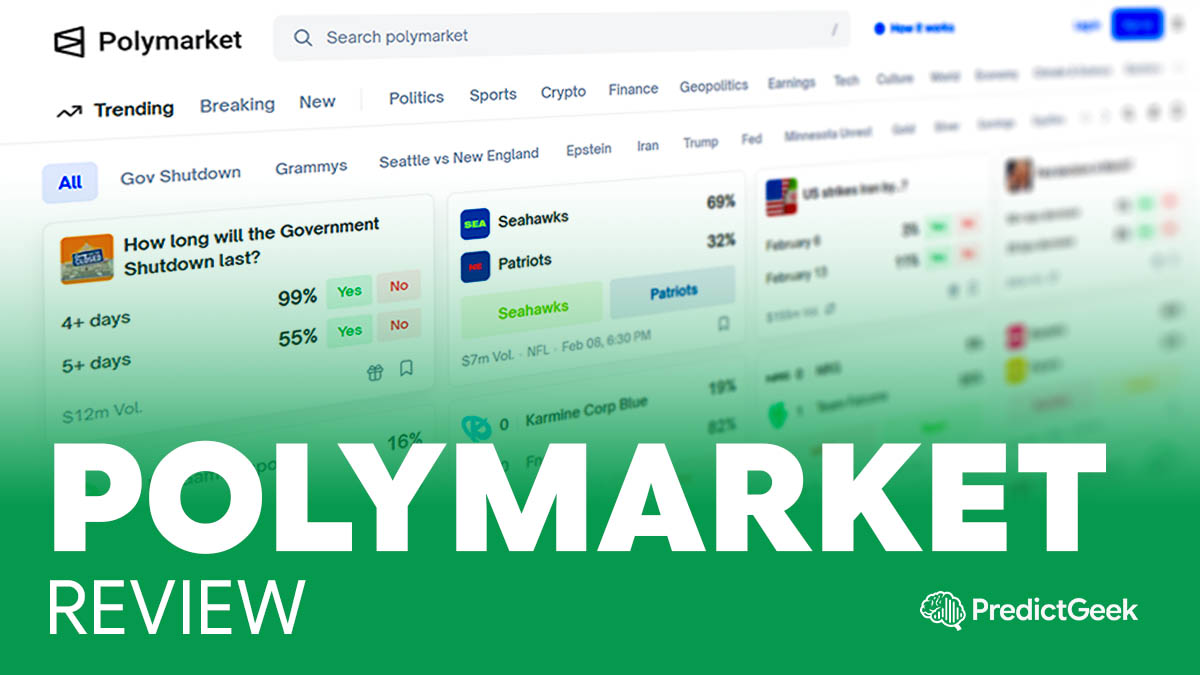
I’ve spent weeks testing Polymarket for PredictGeek, in addition to the time I’ve been using the platform myself, and in this hands-on Polymarket review, I’m walking you through everything I learned while trading on the platform.
You’ll get the real story on how it works, what makes it different, and whether it’s worth your time and money.
I’ve tested the mobile app, analyzed fees, compared it against competitors, and even reached out to customer support at odd hours to see how responsive they are. Read on to learn what stands out.
What is Polymarket? A Quick Summary
Polymarket is a prediction market where you can trade on world event contracts, just like you can do in Kalshi and other similar platforms.
Polymarket survived a regulatory ban, a DOJ investigation, and years of being blocked in the world’s biggest market and came out the other side as the highest-volume prediction market on the planet, backed by the parent company of the New York Stock Exchange.
That kind of trajectory tends to get people’s attention, and it’s exactly why so many traders, journalists, and even policymakers are paying close attention to what this platform says about the future.
| Founded | 2020 |
| Headquarters | New York City |
| Blockchain | Polygon |
| Base currency | USDC (stablecoin, 1:1 to USD) |
| Monthly trading volume | ~$3B+ (peak October 2025) |
| Markets available | Politics, sports, crypto, finance, tech, culture, weather, esports |
| Regulation (US) | CFTC-regulated Designated Contract Market (Dec 2025) |
| Global access | ~180 countries |
| Taker fees | 0% (geopolitics) to 1.80% (crypto); US platform flat 0.30% |
| Deposit fee | None from Polymarket; third-party on-ramp fees may apply |
| Withdrawal fee | None from Polymarket |
| Welcome bonus | None (see bonus section) |
Polymarket Prediction Market Promo Code & Bonuses
As of 2026, there is no standalone welcome bonus exclusively for prediction market trades on Polymarket’s official platform.
This is worth stating clearly because a number of third-party affiliate sites promote promo codes as if they come directly from Polymarket, when in reality those bonuses are funded by the affiliate partner, not by the platform itself.
This is actually pretty standard for crypto-native trading platforms. Polymarket’s model has always been built around tight spreads, deep liquidity, and low fees rather than sign-up incentives.
The value is in the trading conditions, not a bonus that comes with strings attached. That said, Polymarket’s official promotions can change at any time, so it’s always worth checking their official website or app directly for any current offers before you sign up.
Polymarket Prediction Market Bonus Terms & Conditions
Since Polymarket does not currently offer a platform-level welcome bonus, there are no official bonus terms to outline here. If that changes, we will update this section accordingly.
What is worth knowing is that the Maker Rebates Program, covered in the trading features section below, is the closest thing Polymarket offers to an ongoing reward for active users.
It pays out daily USDC rebates to traders who add liquidity to the order book through limit orders. It’s not a sign-up bonus, but for regular traders it adds up in a way that a one-time promo rarely does.
How Does Polymarket Work?

Polymarket works on the same core idea as any prediction market, you pick a side on a future event, put money behind it, and collect $1.00 per winning share if you’re right. Losing shares go to zero.
Where Polymarket stands apart is how it’s built. It runs on the Polygon blockchain and uses USDC as its currency. USDC is a stablecoin worth exactly $1.00.
Your funds live in a crypto wallet, not a traditional bank account, and all trades settle automatically via smart contracts with no middleman involved.
Every market is a yes-or-no question. Share prices move between $0.01 and $0.99, and the price doubles as a probability. A “Yes” share at $0.70 means the crowd thinks there’s roughly a 70% chance that outcome happens.
You can buy, hold, or sell your shares at any time before the market closes.
When an event concludes, outcomes are verified by an independent system called the UMA Optimistic Oracle rather than by Polymarket itself. This means no single company decides who wins, instead the resolution is governed by a decentralized protocol and settled on-chain automatically.
A note on funding (more on that below): US users on the domestic platform can deposit with a card or bank transfer, so no crypto experience needed. International users need a crypto wallet loaded with USDC on the Polygon network. Access and available features vary by country, so always check what applies to your location before signing up.
How To Create a Polymarket Account
Getting started on Polymarket is faster than you might expect. Here’s how the process works:
Step 1: Visit the Polymarket Website or Download the App
Go to polymarket.com or download the official Polymarket app from the iOS App Store or Google Play Store. US users will need to use the dedicated US app, while international users can access the platform through the main website or app.
Make sure you’re downloading the official app, not a copycat. Fake Polymarket apps do exist and are a known scam vector in crypto communities.
Step 2: Sign Up With Your Email or Google Account
Creating a Polymarket account takes under two minutes. You can sign up using your email address or by connecting a Google account. If you’re on the global platform, no identity verification is required at this stage.
US users will go through a full KYC process before they can trade, which includes a government-issued photo ID, Social Security Number, proof of residency, and a live selfie, as required under CFTC regulations.
Step 3: Connect a Wallet or Use the Integrated Onboarding
International users need a crypto wallet to trade. Polymarket supports popular options like MetaMask and Coinbase Wallet, or you can use Polymarket’s built-in custodial wallet that’s created for you upon sign-up, which requires no technical setup and is the easiest route for beginners.
US users on the regulated platform trade through registered futures commission merchants (FCMs), so the crypto wallet complexity is largely abstracted away.
Step 4: Fund Your Account
Funding your account is straightforward on both versions of the platform. Full deposit method details, including all available options, fees, and minimums, are covered in the dedicated payment methods section below.
Step 5: Browse Markets and Place Your First Trade
Once funded, you can browse markets by topic (politics, sports, crypto, tech, culture, and more), filter by trending or ending soon, and place your first trade.
To buy shares, simply select the market, choose Yes or No, enter the amount you want to spend, and confirm. Your position is immediately visible in your portfolio, and you can sell at any time before resolution if the price moves in your favor.
Is Polymarket Legit and Safe?

Yes, Polymarket is legitimate and safe, though you should understand what that means in the context of a decentralized platform. Unlike traditional betting sites, Polymarket operates as a decentralized application (dApp) on the Polygon blockchain.
Polymarket’s history gives you more to work with than most platforms, because it has been genuinely tested by regulators and came out the other side with a stronger structure than it started with.
In 2022, the CFTC charged Polymarket with operating an unregistered derivatives exchange and imposed a $1.4 million civil penalty. As part of the settlement, Polymarket agreed to block US users. This was a real compliance failure, and it’s worth acknowledging honestly. However, what happened afterward is equally important.
Rather than cutting corners, Polymarket took a structured approach back to compliance. In July 2025, it acquired QCEX (QCX LLC and QC Clearing), a fully CFTC-licensed derivatives exchange and clearinghouse, for approximately $112 million. The DOJ and CFTC closed their investigations without new charges. By November 2025, the CFTC issued an Amended Order of Designation, allowing Polymarket to operate as a fully regulated Designated Contract Market (DCM) in the US. The US app launched in December 2025.
Polymarket has raised approximately $2.1 billion in disclosed capital. Investors include Intercontinental Exchange (parent of the NYSE), Founders Fund, and Vitalik Buterin. ICE alone announced a strategic investment of up to $1 billion in October 2025. This level of institutional backing doesn’t guarantee anything, but it does signal serious credibility.
Because Polymarket runs on the Polygon blockchain, every trade is publicly verifiable on-chain. Funds are held in smart contracts, not in a centralized database where a platform operator could theoretically misappropriate them. This structural transparency is one of the strongest trust signals on the global platform.
Like any platform where you trade with real money, losses are possible. If your prediction is wrong, your shares expire at $0. Market resolution disputes do occasionally arise, and crypto-related risks such as wallet errors and network issues are real if you’re on the global platform. Neither is a dealbreaker, but both are worth understanding before you fund an account.
Where Is Polymarket Prediction Market Legal?
This is genuinely one of the more complex questions in prediction markets right now. Here’s an honest breakdown:
United States: Polymarket returned to the US market in December 2025 following CFTC approval. At the federal level, it’s legal and operates as a regulated Designated Contract Market. However, state-level challenges are ongoing. Nevada, Massachusetts, Tennessee, Connecticut, and several other states have filed complaints or cease-and-desist orders against prediction market platforms.
Courts have reached conflicting conclusions about whether federal CFTC approval preempts state gambling laws. US users should verify their state’s current status before trading, as availability can change quickly.
International access: Polymarket is accessible in approximately 180 countries through its global platform. However, it is restricted in 33+ jurisdictions as of 2026.
Countries with restrictions include OFAC-sanctioned nations (Russia, Iran, North Korea, Cuba, Syria, Belarus, Venezuela, Myanmar), and a growing list of European countries where regulators have taken enforcement action, including France, Belgium, Switzerland, Poland, Portugal, Hungary, and Italy. Singapore has also added Polymarket to a regulatory blacklist.
The table below gives a general summary of access status by region. Always verify current availability through Polymarket’s official geographic restrictions page before depositing, as this landscape changes frequently.
| Region | General Status |
|---|---|
| United States (federal level) | Legal under CFTC oversight; state-level disputes ongoing |
| Canada | Generally accessible; verify locally |
| United Kingdom | Accessible; check for recent changes |
| Most of Latin America | Generally accessible |
| Most of Asia (ex-Singapore) | Generally accessible, with some country exceptions |
| Singapore | Restricted |
| France, Belgium, Portugal, Italy, Switzerland | Restricted / enforcement actions |
| OFAC-sanctioned countries | Blocked entirely |
*Legal status is subject to change. Always check Polymarket’s official documentation for the most current restrictions in your jurisdiction.
Polymarket App & Mobile Experience Review
Polymarket’s mobile experience has come a long way, though there are meaningful differences between iOS and Android worth knowing before you download.
| iOS App | Android App | Mobile Web | |
|---|---|---|---|
| App Store rating | 4.7-4.8 / 5 | 3.6-3.8 / 5 | N/A |
| Minimum OS | iOS 15.0+ | Varies | Any browser |
| Face ID / biometric login | Yes | Yes | No |
| Push notifications | Yes | Yes | Limited |
| Order book access | Yes | Yes | Yes |
| Apple Pay deposits | Yes (where available) | No | No |
| Best for | Active traders | Casual browsing | First-time users |

iOS App: The iOS experience is the stronger of the two native apps. The interface is built around a tiled grid of active markets, each showing the question, current Yes/No price, implied probability, and trading volume. Live charts and order book depth are a swipe away, and the overall layout makes it easy to react quickly to breaking news without feeling overwhelmed.
Android App: Fully functional but currently rated noticeably lower than iOS, with some users reporting a rougher experience navigating complex positions. Android-specific optimizations are ongoing and the gap has been closing, but it’s worth knowing if Android is your primary device.
Mobile web: Polymarket’s mobile website mirrors most app features and can be installed as a Progressive Web App (PWA) for an app-like experience without a store download. For total beginners, the mobile web version is a perfectly valid starting point before committing to a full app install.
What still needs improvement: the US app currently covers sports markets first with a phased rollout for other categories, and some experienced traders find the mobile experience less capable than desktop for managing complex limit orders.
Markets You Can Trade on Polymarket Prediction Market
One of Polymarket’s biggest competitive advantages is the sheer breadth of its market selection. Here’s a breakdown of what’s available:
Politics

Politics event contracts are Polymarket’s flagship category and where it built its global reputation. Election markets, legislative outcomes, approval ratings, policy decisions, and geopolitical developments all fall here.
Political markets can get granular. From overall Senate control down to county-level primary outcomes. Geopolitics and world events markets within this broader category are completely fee-free, which is a notable advantage for politically focused traders.
Sports
Sports prediction markets are now the dominant category in the US. The Polymarket US app launched with sports as its first category. Coverage spans major leagues including NFL, NBA, MLB, NHL, college sports, soccer, tennis, golf, Formula 1, UFC, and esports.
Markets cover game outcomes, championships, player awards, and season milestones. Sports markets carry the lowest taker fee of any fee-bearing category (see the fees section below).
Crypto
Polymarket offers real-time crypto price prediction markets, including short-duration markets as brief as 15 minutes on assets like Bitcoin, Ethereum, Solana, and XRP. These are among the most active markets on the platform and carry the highest taker fee rate due to the high-frequency nature of the trading.
Crypto markets also include longer-term questions like regulatory outcomes, project launches, and network milestones.
Finance & Economics
Markets in this category cover macroeconomic data releases (CPI, Fed rate decisions, GDP, jobs reports), equity market events (IPOs, earnings outcomes), and broader economic questions.
Macro markets have seen a significant surge in activity, particularly 0DTE-style contracts centered around Fed decisions and inflation prints. The finance prediction markets carry a higher maker rebate than most others, which Polymarket has used to incentivize liquidity in this growing category.
Technology & AI
Markets covering product launches, AI model releases, regulatory decisions, and tech company milestones. The AI category in particular has seen rapid growth as interest in tracking real-time developments in artificial intelligence has exploded.
Questions like “Will [AI model] outperform [benchmark]?” are popular in this space.
Culture & Pop Culture
Celebrity news, award shows, social media events, reality TV outcomes, and viral internet moments. Polymarket’s culture markets tend toward fun, trending topics, which sets it apart from Kalshi’s more strictly verifiable approach in the same category.
This is where Polymarket’s decentralized market creation model shines.
Weather
Weather outcome markets, covering questions like hurricane formation, seasonal temperature anomalies, and major weather events. A niche but growing category with a dedicated following among traders who follow meteorological data closely.
Esports
Live esports markets covering tournaments and match outcomes across major titles and competitive gaming leagues. One of the few prediction market platforms that takes this category seriously.
Polymarket Trading Features & Tools
Polymarket is built around a Central Limit Order Book (CLOB), which sets it apart from simpler platforms that use automated market makers.
In plain terms, this means your trades are matched against real orders from other users at prices you both agree on, rather than through an algorithm that adjusts prices automatically. It’s a more sophisticated setup, and it shows up in tighter spreads and more predictable execution on liquid markets.
The two order types you’ll use most are market orders and limit orders.
- Market orders execute immediately at the best available price and are subject to taker fees.
- Limit orders sit in the book until someone matches your price, cost nothing in fees, and actually earn you daily USDC rebates through the Maker Rebates Program.
For most categories, that rebate is approximately 25% of the fee your counterparty paid. It’s a small but real edge that experienced traders take seriously, and one of the more underappreciated features on the platform.
Beyond order execution, the live order book on each market shows you all pending buy and sell orders in real time. This is genuinely useful for reading where liquidity sits and spotting large position walls before you trade into them.
Pair that with the price history chart on each market, showing how implied probability has shifted over time, and you have enough information to make a reasonably informed entry decision without needing any external tools.
For power users, Polymarket’s API is one of the strongest in the prediction market space, supporting real-time market data, automated trading, and custom tool builds. This is an area where Polymarket clearly leads newer, more consumer-focused competitors that don’t offer developer access at all.
Polymarket Fees & Trading Costs
Polymarket’s fee structure has evolved significantly. Here’s the current picture:
International (Global) Platform Fees
Polymarket uses a probability-based dynamic fee model for taker orders. The core concept: the closer a market’s implied probability is to 50%, the higher the fee.
Fees decrease as prices approach either extreme ($0.01 or $0.99). This design keeps trading affordable on high-confidence markets while applying higher costs to coin-flip uncertainty, where high-frequency scalping is most common.
Fees apply to takers only. Makers pay zero fees and earn rebates.
| Market Category | Peak Taker Fee (per 100 shares at $0.50) | Maker Fee |
|---|---|---|
| Crypto | $1.80 (1.80% peak) | $0 + rebate |
| Economics / Culture / Weather | $1.25 (1.25% peak) | $0 + rebate |
| Politics / Finance / Tech / Mentions | $1.00 (1.00% peak) | $0 + rebate |
| Sports | $0.75 (0.75% peak) | $0 + rebate |
| Geopolitics & World Events | $0 (fee-free) | $0 + rebate |
Fees are symmetric around $0.50 and decrease toward both extremes. A trade at $0.30 incurs the same dollar fee as a trade at $0.70. Very small trades near price extremes may incur no fee at all. Rates are subject to change; verify current fees at docs.polymarket.com.
US Platform Fees
The US exchange uses a simpler flat-rate model: a 0.30% taker fee on total contract value, with a 0.10% maker rebate credited back on filled limit orders.
Check Polymarket’s official US fee schedule for any current temporary rebate promotions, as these are updated periodically.
Deposit and Withdrawal Fees
Polymarket itself charges no deposit or withdrawal fees for USDC. Third-party on-ramps like MoonPay typically charge 1-3% for fiat-to-crypto conversions, and blockchain gas fees on Polygon are typically under $0.01 per transaction.
Withdrawals incur approximately 0.08% slippage on conversion. Full details are in the payment methods section below.
Polymarket Trading Limits & Liquidity
Understanding limits and liquidity is crucial for developing an effective Polymarket trading strategy. These factors determine how much you can trade and how efficiently you can enter and exit positions.
No hard trading size limits: By design, Polymarket’s order book does not impose official position size caps. It matches willing buyers and sellers of any amount. In practice, your position size is constrained by available liquidity in each market rather than any platform rule.
Minimum trade size: There is no official minimum, though a practical floor of around $5-20 makes sense to cover network costs and buy enough shares to move the needle on your position.
Liquidity: This is where Polymarket genuinely separates itself. Popular markets on major elections, prominent sports events, and Fed rate decisions can have millions of dollars in outstanding orders, which translates to tight spreads (often 1-2 cents on the most liquid markets) and the ability to enter and exit large positions without dramatically moving the price.
Average spreads tightened from approximately 4.5% in 2023 to around 1.2% by late 2025. On niche markets with fewer participants, spreads can widen to 5-10 cents, which adds meaningfully to your round-trip cost. Always check order book depth before placing a large trade.
Withdrawal limits: Polymarket imposes no withdrawal limits, cooldown periods, or lockup requirements. Your “Available to Trade” balance on the portfolio page reflects what’s withdrawable at any time, excluding funds tied up in open positions.
Polymarket Event Trading Strategies & Tips
Prediction markets reward accurate thinking and disciplined execution. Here are three strategies that are particularly well-suited to how Polymarket works:
1. Use Limit Orders to Eliminate Taker Fees
One of the most actionable things you can do on Polymarket is simply default to placing limit orders instead of market orders. Takers pay fees. Makers pay zero fees and earn daily USDC rebates funded by those same taker fees.
If you’re not in a rush to enter a position, placing a limit order a cent or two inside the best price is almost always worth the wait.
This approach turns a potential cost into a potential source of passive income from the Maker Rebates Program. The savings compound quickly if you’re trading regularly.
2. Focus on Geopolitics and World Events Markets for Zero-Fee Trading
Geopolitics and world events markets are permanently fee-free on Polymarket.
If you have an edge in this category, whether from a background in international relations, government, or simply following global news closely, these markets offer the best pure-edge environment on the platform.
No fees means every bit of predictive accuracy goes straight to your returns. On a coin-flip market with a 1.00% fee elsewhere, a correct 55% read only nets you about 4.5% after fees. In geopolitics markets, that same edge is preserved in full.
3. Trade Price Swings, Not Just Resolutions
A common beginner mistake on Polymarket is treating it like a bet you place and forget.
You don’t have to wait for market resolution to profit. If you buy Yes shares at $0.35 on a political market and news breaks that shifts the probability to $0.60, you can sell immediately and lock in your gain without waiting for the event to conclude.
This approach lets you trade the market’s reaction to information flow, which is often faster and more reliable than trying to call the final outcome.
Important: Trading on prediction markets involves real financial risk. You can lose the money you invest. Past accuracy of markets does not guarantee future outcomes. Only trade with funds you can afford to lose.
Polymarket vs Other Prediction Markets
We’ve spent a good amount of time finding the best Polymarket alternatives out there. Here is how Polymarket squares off against top competitors in the industry.
Polymarket Prediction Market vs Kalshi
Kalshi and Polymarket are the two biggest names in prediction markets right now, and they attract somewhat different users for good reason.
Polymarket is the global liquidity leader. It has deeper order books on high-profile markets, a wider variety of market topics (especially in crypto, culture, and niche current events), lower fees for international users, and a fully transparent on-chain settlement model.
The trade-off is that the global platform requires a crypto wallet and USDC, which adds friction for users coming from traditional finance.
Kalshi is the most established fully regulated US exchange. It has been CFTC-licensed longer than any competitor, offers a simpler fiat-funded experience, and pays approximately 4% APY on uninvested cash balances, a feature Polymarket doesn’t offer.
Kalshi’s market catalog is deep in political, economic, and macro categories, and the interface feels more like a traditional financial app. For US users who find the crypto element of Polymarket uncomfortable, Kalshi is the natural alternative.
Polymarket Prediction Market vs Manifold Markets
Manifold Markets is a free-to-play prediction platform that uses play money rather than real USDC or dollars. It is a great learning environment for understanding how prediction markets work before putting real money at stake, with an active community creating hundreds of niche markets.
However, because there’s no real money involved, the incentives are different, and market accuracy may not reflect true economic conviction. If you want to practice before committing real funds, Manifold is a useful stepping stone.
If you want real-stakes markets with meaningful liquidity, Polymarket is the step up.
Polymarket Payment Methods: Deposits & Withdrawals
Deposits
Polymarket’s payment options depend on which version of the platform you’re using:
Global Platform
| Method | Notes |
|---|---|
| Direct USDC transfer (Polygon) | Lowest cost, fastest; requires existing crypto wallet |
| MoonPay (integrated) | Debit card, credit card, bank transfer; 1-3% provider fees apply |
| Coinbase Pay | Straightforward if you already hold USDC on Coinbase |
| Other non-USDC tokens | Automatically converted; standard DEX swap spreads apply |
US Platform
| Method | Notes |
|---|---|
| ACH bank transfer | Standard processing time; typically lowest fees |
| Wire transfer | Faster for larger amounts |
| Debit card | Instant; processing fees may apply |
| Apple Pay | Convenient; availability depends on region |
Polymarket itself does not charge deposit fees. Third-party providers apply their own fees, and blockchain gas on Polygon is typically under $0.01 per transaction for direct transfers.
Withdrawals
Withdrawals on the global platform are processed in USDC to your connected wallet, with near-instant settlement (typically seconds on Polygon).
Polymarket does not charge a withdrawal fee, though approximately 0.08% slippage applies to the conversion. To convert USDC back to fiat, you’ll need to send it to a centralized exchange (Coinbase, Binance, Kraken, etc.) and sell from there, which may incur those platforms’ own fees.
There are no withdrawal limits, cooldown periods, or lockup requirements on Polymarket. Your “Available to Trade” balance on the portfolio page is what’s withdrawable at any time.
Customer Support & Help Center
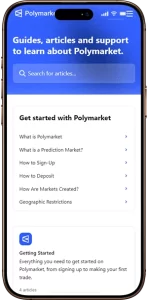
Polymarket covers the main support bases, though the experience varies depending on which channel you use.
- Live chat is available directly on the Polymarket website via the blue chat icon in the bottom-right corner of the screen. It’s the fastest route for simple account or deposit questions, though response depth can be limited for anything technical.
- Discord is where most of the real support happens. Polymarket’s server is large and active, and the community itself often answers questions faster than the official team does. To open a formal ticket, navigate to the Support sidebar and click #open-a-ticket, which opens a private conversation with a verified team member (identifiable by blue font). This is the recommended route for account-specific or dispute-related issues.
- X (formerly Twitter) via @PolymarketHelp handles account DMs and general questions. Useful for quick queries but not ideal for anything requiring back-and-forth.
- Email at [email protected] is listed as a general contact address, though response times tend to be slower than Discord for most issues.
- The Help Center at help.polymarket.com is well-structured and covers the most common topics: account setup, deposits and withdrawals, market mechanics, and resolution disputes. Worth checking before opening a ticket, as most standard questions are answered there clearly.
Security tip: Polymarket team members will never DM you first on Discord and will never ask for your private keys or personal information. Unsolicited DMs claiming to be Polymarket support are almost always scams. This is one of the most common attack vectors in crypto communities, and it’s worth staying alert to.
Our Final Words on Polymarket
No prediction market has had a stranger, more eventful journey to legitimacy than Polymarket, and that history is actually part of why it’s worth taking seriously now. A platform that survived a federal investigation, paid a $1.4 million fine, rebuilt its compliance infrastructure from scratch, and still emerged as the world’s highest-volume prediction market has been genuinely stress-tested. Most of its competitors haven’t been.
What stands out in practice is the depth of what’s on offer. The global platform’s crypto onboarding remains a real barrier for complete beginners, and the US platform is still in early stages, with a more limited market catalog compared to what international users access. Contentious resolutions through the UMA oracle can also create uncertainty in edge cases, though they’re genuinely rare.
Polymarket is the right platform if you want the deepest markets, the sharpest pricing, and the most transparent infrastructure in the prediction market space.
If you’re coming from traditional sports betting and want something simpler and crypto-free, Kalshi or other sports-focused platforms may suit you better as a starting point. But if your goal is to trade on real-world events with the most liquidity behind you, this is where you want to be.
Polymarket Prediction Market Trading FAQs
Yes, at the federal level, following its CFTC approval and regulated relaunch in December 2025. However, several states are pursuing their own legal challenges, and access may be restricted depending on where you live. Always verify your state’s current status before trading.
On the global platform, yes, a crypto wallet is required, though Polymarket’s built-in custodial wallet handles this for you with no technical setup needed. On the US platform, you can trade using traditional payment methods like ACH and debit card with no crypto wallet required.
The global platform uses USDC, a stablecoin pegged 1:1 to the US dollar. The US platform uses USD directly. Winning shares always pay out $1.00 per share regardless of which platform you’re on.
Yes, as of 2026. Taker fees vary by market category, from 0.75% peak on sports markets to 1.80% peak on crypto markets. Geopolitics markets remain permanently fee-free. Limit orders (maker orders) are always free and earn rebates. The US platform charges a flat 0.30% taker fee.
Through taker fees on most market categories. Prior to 2026, the platform operated without trading fees entirely, focusing on user growth and market depth over monetization.
Yes. If your prediction is wrong, your shares expire at $0 and you lose the amount you invested. Only trade amounts you are prepared to lose.
On the global platform, a dispute triggers the UMA Optimistic Oracle process. A new resolution proposal is submitted, and if that is also disputed, the case escalates to a vote among UMA token holders, which typically takes 48-96 hours to resolve. Around 98.5% of markets never reach this stage. On the US platform, disputes are handled through the regulated DCM process under CFTC oversight.
The global platform has a learning curve, mainly because it requires USDC and some familiarity with crypto wallets. That said, Polymarket’s built-in custodial wallet removes most of the technical friction. The US platform is more beginner-friendly, using traditional payment methods and a simpler interface. Either way, start small, read the resolution criteria on any market before you trade, and treat your first few trades as a learning experience rather than an income opportunity.
Polymarket is accessible in approximately 180 countries but restricted in 33+ jurisdictions as of 2026. Always check Polymarket’s official geographic restrictions page before depositing, as this list changes frequently.
Polymarket does not set an official minimum deposit. Third-party on-ramps like MoonPay have their own minimums (typically $20-30 for card purchases). Direct USDC transfers on Polygon can be as low as a few dollars.
Not directly from the global platform. Winnings are withdrawn as USDC to your crypto wallet, then converted to fiat on an exchange like Coinbase before being sent to your bank. The US platform’s withdrawal process is more streamlined toward traditional banking
