
My beat at PredictGeek is mostly sports markets, so a few years back, I would have told you “culture prediction markets” meant some side menu nobody clicked on. That changed fast.
Awards season alone can now pull tens of millions of dollars in trading across the major platforms, and my inbox started filling up with questions from traders who’d wandered into a Grammys market and wanted to know if it worked the same way.
This guide covers what culture prediction markets are, how the contracts work, the five apps that do this category best right now, the main contract types you’ll run into, some trading tips I’ve picked up watching this space grow, and the legal and responsible-trading basics every new trader should know going in.
What Are Culture & Entertainment Prediction Markets?
A culture prediction market is just a regular event-contract exchange that lists questions about movies, music, television, awards shows, and celebrities.
You’re buying a share in one side of a yes/no question, and the price of that share reflects what the crowd of traders thinks the odds are.
Take a question like whether a particular nominee will win a major award. A Yes contract trading at 70 cents means the market sees roughly a 70% chance of that happening. A win pays the contract out at a dollar, and a loss leaves it worth nothing. You can also sell out of a position before the result is known, which matters in a category where sentiment can swing on a single interview or a viral clip.
What turned this from a novelty into a real category is volume. Awards season has become one of the busiest stretches of the year on several platforms, with weekly culture-market activity sometimes spiking several hundred percent around a single ceremony. Add in music charts, reality TV, box office numbers, and the constant churn of celebrity news, and you’ve got a category that trades nearly every day, not just during a handful of live broadcasts.
Pro Tip: Read exactly how a market resolves before you trade it. Award categories occasionally produce ties, last-minute disqualifications, or other edge cases, and platforms don’t all handle them the same way. Same real-world result, can have different outcomes for traders on different platforms, because the contract language differs.
Best Culture Prediction Market Apps in October 2026
I picked these five because each one earns its spot in the culture and entertainment category specifically, not as an afterthought bolted onto a different vertical.
Kalshi

Kalshi is the platform most US culture traders end up on sooner or later, and for good reason.
As a CFTC-regulated Designated Contract Market, it runs the broadest culture menu I’ve found anywhere, with dedicated sections for Oscars, Emmys, Grammys, television, video games, and even “frequency” markets where you’re trading on whether a specific word or phrase gets said during a live broadcast. There’s also a Love Island vertical, which tells you how seriously this platform takes the reality TV crowd.
Trading fees scale with how close a contract sits to a coin-flip, peaking at roughly 1.75% of contract value at 50 cents and shrinking the closer a price gets to either extreme, so a near-lock contract barely costs you anything to trade. ACH deposits and withdrawals are free, and your uninvested cash balance earns interest, a small but useful touch for anyone parking money between awards seasons.
Polymarket

Polymarket has the deepest and weirdest culture catalog in the business internationally, with standalone categories built around individual celebrities like Taylor Swift and MrBeast, plus markets on everything from Rotten Tomatoes scores to celebrity life events.
There’s a wrinkle worth knowing before you go looking for that depth, though: there are technically two Polymarkets. The original international exchange, the one with the wall-to-wall celebrity coverage, has been geoblocked for US users since a 2022 CFTC settlement and stays that way.
Polymarket US, the separate CFTC-regulated exchange US residents can legally use, launched in December 2025 with a narrower category list that has expanded gradually since.
The US app is adding political, economic, and a growing slice of cultural contracts, but the category depth still lags behind the international version, and Android and web access were still rolling out.
Robinhood

If you already use Robinhood for stocks, Robinhood prediction markets (built on Robinhood Derivatives, LLC, routed through KalshiEX or ForecastEX) is the lowest-friction way into culture trading I’ve come across.
The Entertainment category covers Grammys, Golden Globes, Oscars, streaming, music, TV, and gaming, and during a look through the app I found everything from straightforward awards markets to oddball ones like predicting the most-searched person on Google for the year.
The standout for this category is the fee. Only $0.01 per contract, among the cheapest in the industry, and there’s no separate account to open if you’re already a Robinhood user.
PrizePicks Predict

PrizePicks splits its prediction markets into Team Picks and Culture Picks, and the Culture Picks side is where you’ll find awards shows, Billboard and Spotify chart outcomes, and reality TV finishes, all running on Kalshi’s underlying market infrastructure dressed up in PrizePicks’ own mobile-first interface.
I covered the broader Predict product in our full PrizePicks Predict review, and the same multiplier-style display that makes Team Picks easy to read carries over here.
Fees run a flat $0.005 to $0.02 per contract on buys and early sells, with nothing extra if you hold a contract to settlement. For someone who already uses PrizePicks and just wants to dip a toe into entertainment markets without learning a new app, this is about as low-friction as it gets.
OG.com

OG predictions is Crypto.com’s standalone prediction market app, launched in February 2026 and regulated through Crypto.com Derivatives North America.
It pairs a notably useful parlay builder, something no other major CFTC-regulated culture platform offers, with a culture section that holds its own, listing markets on award-show winners (Best Picture, Album of the Year) and year-end pop culture milestones.
The minimum deposit is just $1 via ACH, and new users have access to a tiered welcome bonus worth up to $100. What makes OG.com worth a mention specifically for this category is the combo feature: you can bundle a culture pick with other markets into a single parlay-style position, something most regulated culture-focused exchanges don’t let you do.
Choosing the Best Culture Predictions Platform
| Platform | Best For | Contract Types |
|---|---|---|
| Kalshi | The broadest award-show, music-chart, and mention-market selection | Award winners, chart and box-office thresholds, mention/frequency contracts |
| Polymarket | The widest catalog of dedicated celebrity and pop-culture markets (mainly on the international exchange) | Award winners, celebrity-specific markets, life-event contracts |
| Robinhood | Casual fans who already use the app and want the lowest per-contract fee | Award winners, streaming/box-office thresholds, people and TV markets |
| PrizePicks Predict | Beginners who want a simple, mobile-first interface | Award winners, music chart winners, reality TV outcomes |
| OG.com | Traders who want to combine culture picks into parlay-style positions | Award winners, combo/parlay culture contracts, year-end milestones |
Top Culture Prediction Market Sites for Beginners
If you’re new to this whole world, start with PrizePicks Predict’s Culture Picks. The multiplier-style display does the probability math in the background so you’re not staring down raw cent prices on day one, and the app already feels familiar if you’ve used any mobile pick’em product.
Robinhood is my second pick for the same reason, plus its rock-bottom per-contract fee means early mistakes cost you less while you’re learning the ropes.
Both platforms trade off some market depth for simplicity, which is exactly the right tradeoff for a beginner. You can always graduate to a fuller exchange once you understand how implied probability and contract pricing move.
Entertainment Prediction Apps for Experienced Traders
Once you’ve got the basics down, Kalshi and Polymarket are where the real depth lives, and I’d recommend running accounts on both rather than picking one. The same award-show question can price a few cents apart between the two exchanges, and checking both before you trade takes less than a minute but can meaningfully improve your entry price.
Kalshi gives you the broadest US-legal culture catalog and the lower fee structure at extreme prices, while Polymarket (international depth aside) brings some oddly specific markets you won’t find anywhere else once its US category list catches up.
Experienced traders should also lean on Kalshi’s maker orders, which let you post a limit price instead of paying the full taker fee, something most app-wrapped platforms don’t offer at all.
Types of Culture Prediction Market Contracts
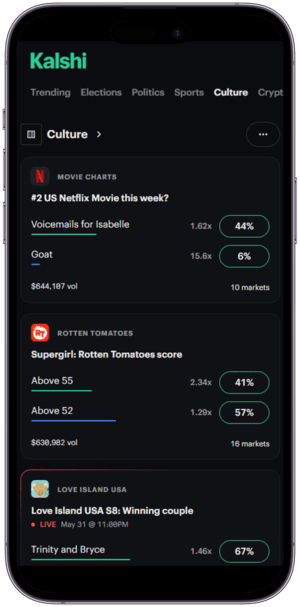
Award-Show Winner Contracts
These are the bread and butter of the category. A single market with multiple Yes/No contracts, one per nominee, where only one side can win (barring the rare tie). Best Picture, Album of the Year, and Outstanding Drama Series all work this way.
Pricing tends to track precursor awards closely, so a frontrunner can shift several cents the moment a guild or critics’ group announces its own pick.
Mention and Frequency Contracts
Kalshi’s frequency markets let you trade on whether a specific word or phrase gets said during a live broadcast, an awards speech, or even a press conference.
They settle fast, usually within the hour, and reward people who pay close attention to a show’s format and the personalities involved rather than industry insider knowledge.
Chart and Box Office Threshold Contracts
Instead of picking a winner, these markets ask whether a number clears a line: will a song hit the Billboard Hot 100 top 10, will a movie’s opening weekend top a set figure, will an album cross a streaming threshold.
They, reward traders who track streaming and box office data rather than just having an opinion about quality.
Reality TV and Elimination Contracts
Competition and dating-format shows get dedicated markets predicting weekly eliminations or the eventual winner. These resolve quickly and trade actively week to week, but liquidity can dry up fast once a season’s buzz fades, so check volume before assuming you can exit easily.
Celebrity Milestone Contracts
This bucket covers life events: engagements, breakups, legal matters, and other personal milestones that generate public interest. They’re some of the most unpredictable contracts in the category, since they depend on private decisions rather than a scheduled, judged event, and pricing can swing hard on a single paparazzi photo or social media post.
Combo and Parlay Culture Contracts
A newer addition, popularized by platforms like OG.com, lets you bundle several culture contracts, or a culture pick alongside another market, into a single combined position.
The payout is higher because every leg has to land, which makes these fun but meaningfully riskier than trading one contract at a time.
Expert Tips for Trading Culture Prediction Markets
1. Track the precursor season
Award shows almost never happen in a vacuum. Guild and critics’ group awards typically land before the major ceremonies and tend to move winner pricing well ahead of the actual broadcast. The same pattern shows up across music awards, where one show’s results often shift the odds for the next one. If a contract hasn’t repriced after a major precursor result, that’s worth a second look.
2. Read the resolution rules before you trade
I touched on this earlier with the tie example. Every platform writes its own rules for how a market settles, and those rules don’t always match what you’d assume from the question alone. Spend two minutes reading the specific market’s resolution criteria, especially for anything involving a tie, a multi-part question, or an award category with a history of surprise calls.
3. Compare prices across platforms
The same award or chart contract can trade a few cents apart on Kalshi versus Polymarket versus a smaller app, since each platform has its own pool of traders setting the price. On a meaningful position, that difference is worth chasing. It costs you nothing but a minute of checking.
4. Stick to markets with real volume
Niche culture contracts, especially in a quiet awards category or a reality show between seasons, can have almost no other traders on the other side of your trade. That makes it hard to exit before settlement if your read changes. While you’re building experience, favor the markets with visible trading activity over the curiosity picks.
5. Use early exit as a tool, not a last resort
You don’t have to hold a contract until the result is announced. If an early precursor win reprices your position favorably, selling early locks in a profit without betting on the final outcome. Decide on a target and a floor before you trade, and let that plan, not the live chatter on social media, decide when you sell.
Are Culture Prediction Markets Legal in the US?
Federally, yes. Most legit prediction market platforms operate as CFTC-regulated exchanges, often holding Designated Contract Market (DCM) status and clearing through Futures Commission Merchants, sometimes alongside National Futures Association oversight. That framework treats event contracts as derivatives rather than gambling.
Plenty of state regulators disagree. More than a dozen states, including Nevada, Massachusetts, Maryland, Illinois, Arizona, and Ohio, have filed suit, issued cease-and-desist orders, or won injunctions against prediction market platforms, arguing that event contracts amount to unlicensed gambling under state law. Courts have split on the question, and the fight is still working through federal appeals.
Most of that legal pressure targets sports prediction contracts specifically, since those draw the closest comparison to traditional betting law. Political, economic, and culture contracts have generally drawn less scrutiny, though less isn’t the same as none.
The legal map keeps shifting state by state, so check your platform’s current eligibility for the category you want to trade before funding an account.
Responsible Trading Practices
Most platforms in this guide offer deposit limits, loss limits, or full self-exclusion tools, and they’re worth setting up before you need them, not after.
Culture markets carry a specific behavioral risk, and it’s the fast-moving, social-media-driven nature of celebrity and entertainment news that can create a fear-of-missing-out pull that other categories don’t usually trigger in the same way.
If you notice yourself chasing a market because everyone’s talking about it rather than because you have an actual read on the outcome, that’s a signal to step back.
There’s no guarantee of profit in any of this, and outcomes in entertainment can be just as unpredictable as anything else on these platforms, sometimes more so given how often awards shows produce a result nobody priced in.
If you or someone you know is showing signs of a gambling problem, the National Council on Problem Gambling’s helpline (1-800-GAMBLER) is free, confidential, and available around the clock.
My Opinion on Culture Prediction Markets
I came into this category skeptical that it would amount to much more than a novelty wrapped around awards season, and the trading volume changed my mind.
There’s something fitting about a category built on uncertainty (who really knows what an awards body will reward, or which song breaks through on a given week) finding a home in a format designed to price uncertainty. The variety, from award shows down to reality TV elimination odds, gives this corner of prediction markets more staying power than I expected when I started covering it.
Here’s my take for anyone considering trading culture contracts: treat it like any other prediction market, not a celebrity gossip column with a payout attached. Read the resolution rules, watch your bankroll, and remember that the volatility that makes this category fun (a single interview or a leaked setlist can move a contract by ten cents in minutes) is exactly what makes it risky.
Used carefully, it’s one of the more entertaining ways to put real analysis behind opinions you already have about the culture around you. Used carelessly, it’s a fast way to lose money chasing a hunch. I’d rather see you do the former.
Trading in prediction markets involves real financial risk. Contract availability, platform access, fees, and legal status may vary by jurisdiction and are subject to change. Always verify current terms directly with the platform before trading. This content is for informational purposes only and does not constitute financial or legal advice.
