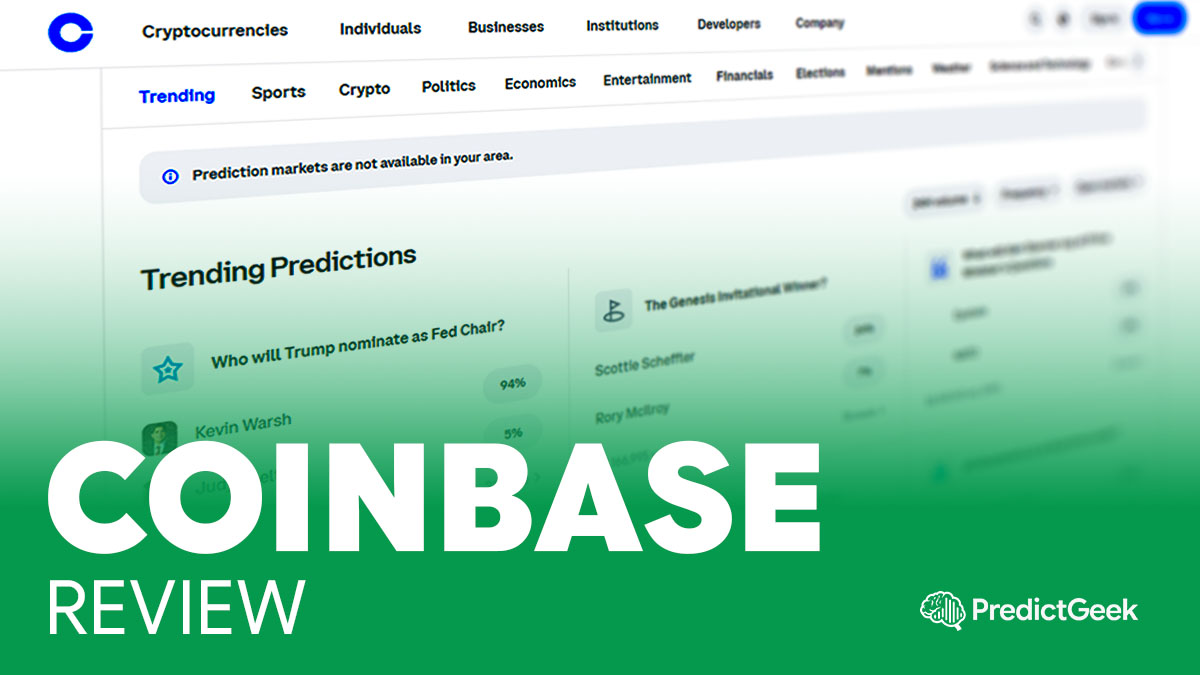
Coinbase built its reputation on crypto trading. Now it wants a seat at the table for event forecasting too.
We spent time testing the live markets inside Coinbase in 2026. Not just browsing the interface but placing positions, watching spreads during volatile moments, and comparing execution quality against dedicated event-trading platforms.
This review breaks down how the Coinbase predictions actually work. You will see where it feels strong, where it still depends heavily on market depth, and who this product realistically fits.
If you are considering adding Coinbase event contracts to your trading routine, read on to learn more before jumping in.
What Is Coinbase Prediction Markets? A Quick Summary
Coinbase Prediction Markets are a product inside the Coinbase ecosystem that allows you to trade event contracts.
Inside the app, you will see markets built around real-world events. Each one revolves around a single question. If the event happens, the contract pays out in full. If it does not, it expires at zero. The current price reflects what traders collectively believe right now, and that number moves as new information hits the market.
You are still inside the same account. Same balances. Same funding flow. The difference is that instead of buying an asset that can drift up or down forever, you are taking a position on a specific outcome with a clear resolution date.
What makes this distinct is not the concept itself, but the environment. You are trading these event contracts inside a regulated U.S. brokerage framework. Your USD or USDC sits in the same Coinbase ecosystem you already use, and positions appear alongside your other holdings. There is no separate wallet, no third-party transfer, and no parallel login to manage.
If you value regulation, convenience, and keeping everything consolidated under one trusted platform, Coinbase Prediction Markets functions as an integrated forecasting layer rather than a standalone speculation site.
| Coinbase Feature | Details |
| Regulation | CFTC-regulated (via Coinbase Financial Markets) |
| Minimum Trade | $1 per contract |
| Supported Funding | USD, USDC |
| Availability | All 50 U.S. states (as of 2026) |
| Mobile App | Yes |
| Advanced Tools | Limited |
Current Coinbase Prediction Markets Welcome Bonus
As of 2026, there is no standalone welcome bonus exclusively for prediction market trades.
When we reviewed the live promotions inside Coinbase, the available offers were tied to crypto activity. Examples typically include trading credits, small crypto rewards for completing certain actions, or referral bonuses when a new user signs up and meets minimum funding thresholds.
Those incentives can still indirectly benefit you if you plan to fund your account anyway. But they are not structured as “deposit $X, get $Y for prediction markets” the way some betting platforms operate.
If Coinbase decides to push prediction markets more aggressively in the future, that could change. For now, the rollout appears focused on product expansion rather than heavy promotional spend.
Other Promotions at Coinbase
Coinbase periodically runs ecosystem-wide campaigns. These may include:
- Referral bonuses
- Limited-time trading incentives
- Earn-style educational rewards
- Tier-based fee discounts for higher activity
While these promotions are not prediction-specific, they can offset costs elsewhere in your account. If you are already trading crypto or holding USDC, stacking those benefits can indirectly improve your overall efficiency on the platform.
Before assuming a bonus applies, always check the promotion details directly in your account dashboard. Offers can vary by region and user eligibility.
How to Start Trading Events at Coinbase
Here is how you position yourself to participate in Coinbase’s prediction markets the right way.
1. Sign Up for a Coinbase Account
If you are new to Coinbase, you will need to create a standard account first. The process is the same whether you plan to trade crypto, stocks, or event contracts.
If you already have an account, there is nothing new to open. Prediction markets are built into the existing infrastructure.
One important detail we noticed during testing in 2026 is that eligibility may depend on your verified status and jurisdiction, so make sure your account profile is fully completed.
2. Complete Verification
Coinbase operates under U.S. regulatory oversight, which means identity verification is not optional. You will need to submit standard documentation before accessing full trading features.
This step unlocks higher limits and ensures you can participate in all supported products, including prediction markets. Skipping verification usually restricts functionality.
If you plan to move meaningful capital, complete this early rather than waiting until you are ready to place a trade.
Fund Your Wallet
You can fund your account with USD through linked bank transfers or deposit USDC directly if you prefer operating in stablecoins.
In practice, many event contracts are settled and priced conveniently using USD or USDC balances. Keeping funds already inside Coinbase eliminates extra transfer friction compared to external platforms.
Before depositing, check any applicable funding fees or hold periods so you are not surprised by temporary withdrawal restrictions.
3. Access the Prediction Markets Section
Once logged in, navigate to the dedicated Prediction Markets tab within the app or web interface.
The layout is integrated into the broader Coinbase dashboard, so you do not switch platforms or create sub-accounts. Markets are organized by category, expiration date, and event type.
If you do not see the tab, double-check availability in your state and ensure your account is fully verified.
4. Start Trading
Select a market that matches your interest and risk tolerance. Review the current price, liquidity, and expiration timeline before placing your order.
Choose the number of contracts you want to purchase, confirm the total cost, and execute the trade.
We recommend starting small if you are new to event contracts. Watch how pricing moves as new information comes in. Understanding that rhythm before increasing size will help you avoid emotional decision-making.
Is Coinbase Prediction Markets Legit and Safe?
Yes. Coinbase Prediction Markets operates through Coinbase Financial Markets, a CFTC-regulated entity and member of the National Futures Association. That means these contracts fall under federal derivatives oversight rather than state gambling frameworks.
From a security standpoint, your USD or USDC remains inside Coinbase’s existing custody infrastructure. The same account protections you use for crypto trading apply here as well.
That said, regulation does not remove trading risk. You can lose the full amount you commit to a contract if the outcome does not occur. Liquidity can also vary depending on the market.
There are ongoing legal debates in some states about prediction markets, so availability may depend on your jurisdiction. We’ll cover that next.
Where Is Coinbase Prediction Markets Legal?
As of 2026, Coinbase Prediction Markets is available across all 50 U.S. states following its nationwide rollout through its partnership with Kalshi, a CFTC-regulated exchange.
Because these contracts operate under federal futures law rather than state gambling rules, Coinbase can offer them broadly at the national level. That federal framework is what allows the product to scale across the country instead of navigating individual sportsbook licenses state by state.
That said, prediction markets remain a politically sensitive topic. A few states have questioned whether event contracts resemble gambling, and legal debates continue in certain jurisdictions. Availability can change if regulatory challenges evolve.
Outside the United States, access depends entirely on local derivatives regulations. Some countries restrict event-based contracts, while others treat them as financial instruments. Before trading, confirm that your region supports this type of product inside your Coinbase account.
If you are in the U.S., access is currently broad. If you are international, eligibility is not guaranteed and should be verified directly within the platform.
Coinbase App & Mobile Experience Review
Coinbase did not build a separate app for prediction markets. It lives directly inside the main Coinbase interface, and that integration is the biggest usability advantage.
From our testing, the experience is clearly designed for accessibility over complexity. You can scroll through available markets, tap into a contract, review pricing, and execute within seconds. Funding is seamless because your USD or USDC balance is already connected to the order ticket.
Compared to standalone prediction platforms, this removes friction. You do not need a new account, a separate dashboard, or additional transfers. Everything sits under one login.
The tradeoff is depth. Advanced charting, detailed order book analytics, and professional trading tools are limited. If you are used to highly customizable market interfaces, you may find it basic.
On mobile specifically, performance has been stable. Orders process quickly and price updates remain responsive. There are occasional scheduled maintenance windows, typically during low-activity hours, when markets may pause briefly. For most casual and mid-level traders, that will not be disruptive. If you plan to trade around major announcements, it is worth being aware of maintenance timing.
Overall, the mobile and app experience prioritizes simplicity and familiarity, which aligns with Coinbase’s broader design philosophy.
Markets You Can Trade on Coinbase Prediction Markets
Coinbase organizes its prediction markets by event type, and the range is broader than many people expect. Instead of focusing on a single niche, the platform spreads activity across several real-world categories, all operating within the same regulated structure.
Here’s what you can typically find in 2026.
Sports
Sports prediction markets cover major leagues and headline events. You will usually see contracts tied to game winners, championship outcomes, or specific performance milestones.
Liquidity tends to be strongest around high-profile matchups. If you are trading sports contracts, focus on major events where participation is highest and spreads are tighter.
Politics
Political markets include elections, primary races, and other nationally relevant outcomes.
These contracts often attract attention because they combine public sentiment with real-time information flow. Pricing can shift quickly around debates, polling releases, or breaking news, so timing matters.
Economic Data
Some markets are tied directly to scheduled economic releases. Examples include inflation reports, employment data, or other macroeconomic indicators.
These contracts are usually driven by defined release dates, which makes them more structured. Volatility often increases right before and immediately after official data announcements.
Culture & Lifestyle Events
You may also find contracts linked to entertainment awards, media events, or culturally significant milestones.
These tend to have lighter liquidity than politics or sports, but they offer variety if you prefer following entertainment or social trends.
Crypto & Financial Events
Given Coinbase’s roots, crypto-related prediction markets are a natural fit. You will see contracts tied to price thresholds, major financial decisions, or other industry triggers.
These can move sharply when market sentiment changes, especially during high-volatility periods in the broader crypto space.
Overall, the selection balances mainstream appeal with event-driven speculation. Before trading any category, check volume and spread. Popular markets generally provide smoother execution, while niche contracts can be thinner and more volatile.
Coinbase Prediction Markets Trading Features & Tools
Coinbase keeps the toolset simple, and that is intentional. The platform is built for clarity and ease of use rather than advanced trading customization.
Here are the core features you will interact with:
Price as Probability
Every contract displays a price that reflects the market’s current implied probability. If a contract trades at $0.62, the crowd is pricing in roughly a 62 percent chance of that outcome occurring.
You do not need to convert odds formats or interpret sportsbook lines. The number on the screen already tells you what the market believes.
Unified Wallet
There is no separate funding system for prediction markets. You use the same USD or USDC balance that sits in your Coinbase account.
This reduces friction. You can move between crypto trades and event contracts without transferring funds between platforms.
Real-Time Pricing
Prices update continuously as traders buy and sell. During major events or breaking news, you can see contracts move quickly.
Execution is straightforward. You select your position size, confirm the order, and the contract appears in your portfolio alongside your other holdings.
Market Filters
Markets are organized by category and expiration date. You can filter by event type or browse upcoming contracts to find opportunities aligned with your interests.
This makes navigation manageable even as new markets are added.
Tooling Limitations
Where Coinbase keeps things basic is in analytics. Advanced charting, deep order book visualization, and complex trading tools are minimal compared to specialized prediction exchanges.
For beginners and casual traders, this simplicity works well. If you rely heavily on technical analysis or granular market data, you may find the interface limited.
Overall, the feature set prioritizes accessibility and integration over professional-grade trading depth, which aligns with Coinbase’s broader design approach.
Coinbase Prediction Markets Fees & Trading Costs
Fees are one area where you need to pay attention inside the app rather than relying on a simple public chart.
As of 2026, Coinbase does not publish a standalone fee table specifically labeled for prediction markets. Instead, costs are built into the trading structure. You will typically encounter:
- Platform fees associated with Coinbase’s brokerage model
- Bid-ask spreads within each market
Partner exchange costs embedded in pricing
In practice, that means your total cost is not just a flat commission. It is a combination of spread and any applicable platform charge at execution.
During our review, we noticed that highly active markets tend to have tighter spreads, which lowers your effective cost. Thinner markets can widen quickly, especially near expiration or during volatile news events. That spread is often the biggest hidden expense.
If you already trade on Coinbase, the fee logic feels familiar. Higher overall activity and using USDC can sometimes reduce relative costs compared to smaller accounts. Still, do not assume rates match crypto trading exactly. Event contracts are structured differently.
Before placing a larger position, always review the order preview screen carefully. Coinbase shows estimated fees and total cost before confirmation. That extra check prevents surprises and helps you understand how much edge you actually need to break even.
Compared to niche prediction platforms, Coinbase prioritizes convenience and integration over ultra-low fee optimization. Whether that tradeoff makes sense depends on how frequently and how aggressively you plan to trade.
Coinbase Prediction Markets Trading Limits & Liquidity
One of the strengths of Coinbase Prediction Markets is accessibility. In most cases, you can start with very small positions. Contracts are typically priced under one dollar, which means you can participate without committing large amounts of capital.
That low entry point makes it easy to test how markets behave before increasing size. If you are new to event contracts, starting small is not just convenient. It is smart.
Liquidity, however, is not uniform across the platform.
High-profile sports matchups, major elections, or widely watched economic releases tend to attract more traders. More participation usually means tighter spreads and smoother execution. Entering and exiting positions feels easier in those markets.
Niche events are different. Volume can be thinner. Spreads may widen. Price swings can look exaggerated because fewer participants are setting the market.
Before placing a larger position, check current volume and order depth. If the market looks thin, your order could move the price more than expected. This is one of the main practical differences between Coinbase and specialized prediction exchanges with deeper order books.
Accessibility is high. Depth depends on the event. Always match your position size to the market’s liquidity profile.
Coinbase Prediction Markets Trading Strategies & Tips
Trading event contracts inside Coinbase is simple on the surface, but your results depend on how you interpret pricing and manage risk.
Here are a few practical principles that matter.
Understand Probability Pricing
Every price on the screen represents the market’s current belief about an outcome.
If a contract trades at $0.80, the crowd is signaling high confidence. That does not mean it is guaranteed. It means you are paying a premium for perceived certainty.
Where beginners get caught is buying late, especially when momentum builds right before an event. Prices can swing sharply as deadlines approach. If you are entering at elevated levels, make sure your edge justifies the risk relative to the payout.
Think in terms of value, not just likelihood.
Diversify Across Events
Putting your entire balance into one contract might feel exciting, but it increases volatility in your results.
Spreading capital across different categories such as sports, politics, or economic releases can smooth performance. Different event types react to different information cycles. That diversification reduces the impact of one unexpected outcome.
In our experience, traders who treat this like portfolio management rather than isolated bets tend to make more disciplined decisions.
Learn the Rules and Timelines
Every contract has a defined resolution process.
Some settle almost immediately after the event concludes. Others may require official confirmation, which can take hours or even days. If you need capital freed up quickly, settlement timing matters.
Before entering a trade, check the expiration date and the resolution criteria. Small wording details can determine whether a contract pays out.
Strategy on Coinbase is less about complex analytics and more about disciplined positioning. Focus on price relative to probability, manage exposure carefully, and always know when and how your contract resolves.
Coinbase vs Other Prediction Markets
Not all prediction platforms are built with the same priorities. Some focus on liquidity. Others lean into betting audiences. Coinbase positions itself differently. It blends event contracts into a mainstream brokerage environment.
Here is how it stacks up against the main alternatives.
Coinbase vs Polymarket
Polymarket is known for active markets and strong liquidity, especially around major political and sports events. If your priority is depth and constant trading activity, Polymarket often feels more dynamic.
Coinbase takes a different approach. It operates under U.S. federal oversight and integrates directly into an established financial platform. You are trading within a regulated brokerage app rather than a crypto-native marketplace.
If you care most about tight spreads and active speculation, Polymarket may feel more alive. If regulation, custody structure, and account consolidation matter more, Coinbase has the advantage.
Coinbase vs Kalshi
Kalshi provides the regulated exchange infrastructure that powers many of Coinbase’s contracts. Its native platform is built specifically for event trading and offers more granular market tools.
Coinbase, on the other hand, simplifies the experience. The interface is cleaner and more accessible, especially if you already use Coinbase for other assets.
In short, Kalshi may appeal to traders who want a dedicated exchange environment. Coinbase appeals to users who want event contracts embedded inside a broader financial account.
Coinbase vs Fanatics Market
Fanatics Markets, tied to the broader FanDuel ecosystem, is expected to target sportsbook users who are already comfortable with betting interfaces.
That audience focus creates a different atmosphere. The tone leans closer to sports wagering culture.
Coinbase stays positioned as a regulated financial platform first. Its edge is integration. Crypto, cash, and event contracts sit under one roof. If you want everything centralized inside a brokerage-style environment, Coinbase stands apart.
Ultimately, the right choice depends on what you prioritize. Liquidity, advanced tools, betting familiarity, or integrated financial infrastructure. Coinbase’s strength is convenience and regulatory structure, not aggressive market depth.
Coinbase Prediction Markets Payment Methods
One advantage of using Coinbase for prediction markets is that you do not need a separate payment setup. Funding and withdrawals run through the same infrastructure you already use for crypto or other supported assets.
Here is how it works in 2026:
| Method | Deposit | Withdrawal | Fees | Speed |
| USD Wallet | Yes | Yes | Varies* | Instant to hours |
| USDC (Stablecoin) | Yes | Yes | Network-dependent | Fast |
*Exact fees depend on your funding method and Coinbase account tier.
USD Wallet
If you link a bank account, you can deposit USD directly into your Coinbase balance. Those funds can then be used immediately for prediction contracts, depending on hold periods.
Withdrawals back to your bank typically process within hours, though timing can vary based on your bank and verification status.
USDC
You can also fund using USDC. Since USDC is natively integrated into Coinbase’s ecosystem, it is commonly used for trading event contracts.
Deposits and withdrawals depend on blockchain network conditions if you are transferring externally. Internal transfers within Coinbase are typically fast.
From a practical standpoint, keeping funds inside Coinbase reduces friction. You are not moving capital between third-party wallets or payment processors just to place trades.
Before funding larger amounts, check current fee disclosures in your account. Transfer costs and timing can vary depending on region, payment method, and account history.
Coinbase Customer Support & Help Center
Prediction markets are supported through Coinbase’s main help infrastructure. You use the same ticketing system and account support channels as crypto trading.
Most issues relate to verification, funding, order execution, or settlement timing. Support responses are generally structured and trackable through tickets.
Live chat may not always be available, and prediction-specific educational material is still lighter than Coinbase’s crypto documentation.
Overall, you are backed by a large regulated company rather than a niche startup, which adds operational reliability.
PredictGeek’s Final Words on Coinbase Prediction Markets
| Pros | Cons |
| Integrated with Coinbase account | Fees not fully transparent upfront |
| Regulated U.S. structure | Limited advanced charting |
| Low minimum entry | Liquidity varies by market |
| Simple interface | Not built for high-frequency trading |
Coinbase prediction market feels like a calculated extension of its brokerage model. Instead of sending users to niche platforms, Coinbase is keeping event trading inside its own regulated ecosystem.
That integration is the platform’s biggest advantage. Funding is simple. Execution feels familiar. Your contracts sit next to your other holdings. If you already trust Coinbase with crypto or cash, adding event positions does not require a leap into a new environment.
That said, this is not the cheapest or deepest prediction platform available. Liquidity varies by market, fees require attention, and advanced analytics are limited. If you are a high-frequency trader or looking for razor-thin spreads, specialized exchanges may suit you better.
But if your goal is accessible, regulated event trading inside a mainstream financial app, Coinbase delivers exactly that.
Coinbase Prediction Markets FAQs
No. Prediction markets are built directly into your existing Coinbase account. You do not create a separate profile or move funds to an external platform. Your positions sit inside the same dashboard where you manage crypto, cash, and other supported assets.
Yes. These contracts operate through Coinbase Financial Markets, a CFTC-regulated entity. That means they are structured as federally regulated event contracts rather than traditional sportsbook bets. Regulation adds oversight, but it does not remove trading risk.
You typically fund positions using USD or USDC already held in your Coinbase account. There is no need to convert to a separate token just to participate in event markets
Prediction market costs are built into platform fees and bid-ask spreads rather than a separate published schedule. Always review the order preview screen to understand your total cost before confirming a trade.
