
In this guide, I’ll break down exactly how weather prediction markets work, which platforms are actually worth signing up for, what types of contracts are out there, and what you need to know before you put any money in.
When I first came across climate prediction markets back in 2021, I thought it was a niche thing that a handful of weather obsessives traded on in their spare time.
I was kind of right about the weather obsessives part. But this category has grown into one of the most active and genuinely interesting corners of the prediction market space, and in 2026, it’s absolutely worth your attention, whether you’ve been following forecasting models for years or you’re just getting started.
What Are Weather Prediction Market Sites?
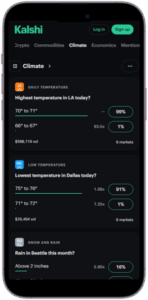
Climate prediction markets are platforms where you buy and sell event contracts tied to specific weather or climate outcomes.
Instead of staring at a forecast app and doing nothing with your opinion about it, you can actually put a position behind what you believe will happen. Get it right, and you collect a payout. Get it wrong, you lose what you put in.
There are Two Types of Climate Markets
The label “climate prediction market” covers two somewhat different things that often get lumped together.
First, you have short-term weather markets, like tomorrow’s high temperature in Miami or whether it’ll snow in Chicago this month. These resolve fast and move with forecast data in real time.
Then you have longer-horizon climate markets, like whether 2026 will rank as the hottest year ever recorded globally, or whether global CO2 levels will breach a specific threshold.
Same category label on most platforms, but a completely different research process and trading rhythm.
How Climate Prediction Markets Work
The mechanics are pretty approachable once you see them in action, so let me walk you through a real example.
Say you find a market asking: “What will the highest temperature in Chicago be on June 10, 2026?” The market lists several temperature range outcomes (“Greater than 78°F,” “Greater than 80°F,” and so on), each priced somewhere between $0 and $1.
You pick the outcome you think will match the official recorded high and buy shares in it. If you’re right when the market resolves, each share pays out exactly $1.00. If you’re wrong, it pays $0.
The price of each outcome reflects the market’s current implied probability. A contract trading at $0.65 means the collective judgment of all traders is roughly a 65% chance that the outcome happens.
Those prices shift in real time as new forecast data, weather model runs, satellite observations, and general market sentiment roll in.
Best Weather Prediction Market Apps in October 2026
There are more options in this space now than there were even a year ago, which is a good thing for traders.
These are the best prediction market platforms I’d actually point someone toward if they asked where to start with climate and weather event contracts.
Kalshi

Kalshi is the platform I keep coming back to for weather markets specifically, and I think it’s the most complete option for US-based traders in this category.
For climate and weather trading, Kalshi runs structured multi-bracket markets covering daily high and low temperatures for major US cities, monthly precipitation (both rain and snow), and longer-horizon contracts around climate change and natural disasters.
Every market contract settles based on the final NWS Daily Climate Report, and something I genuinely appreciate about Kalshi is that you can click into any contract, scroll to the Rules Summary section, and see exactly which data source will determine the outcome.
Kalshi also has an “Ideas” section where traders share their thinking on open markets. I use it mostly as a gut check, not as a trading signal, but as a way to see what narratives other people are working from. Sometimes it’s useful. Sometimes it’s very confident people being very wrong. You learn to calibrate.
Polymarket

Polymarket is the biggest prediction market in the world by volume, full stop.
Its Climate and Science category currently hosts 449 markets, with 212 of those specifically in weather. If breadth and global city coverage are what you’re after, nothing else comes close. Polymarket runs daily high-temperature contracts for cities across six continents.
The big caveat for US readers: Polymarket is currently restricted for US-based traders and operates using cryptocurrency (USDC stablecoin) rather than US dollars. So unless you’re reading this from outside the US, this one is mostly off the table for you right now.
That said, it’s worth knowing about because Polymarket’s climate markets are genuinely impressive in scope.
Robinhood

Robinhood Predictions brings climate event contracts to one of the most widely used investing apps in the country, and the biggest thing it has going for it in this category is how frictionless it is to get started.
If you already have a Robinhood account for stocks or ETFs, you’re basically two taps away from your first prediction market trade. No new account, no new wallet, no learning curve on a platform you’ve never seen.
For climate trading specifically, Robinhood covers daily temperature markets for a solid range of US cities, monthly snowfall and precipitation contracts, and some seasonal weather events.
Temperature contracts resolve based on Weather Underground data from specific airport stations, and the contract rules are clear about which station you’re working with.
For someone who wants to try daily weather markets without a lot of setup overhead, it’s a genuinely good place to start.
Interactive Brokers

Interactive Brokers takes a different approach through its ForecastTrader platform, built on its affiliate exchange ForecastEx.
This one is aimed at a more experienced trading audience, and the climate category reflects that. Rather than daily temperature brackets, IBKR’s climate contracts lean toward longer-horizon indicators: global temperature benchmarks, atmospheric CO2 milestones, annual temperature rankings, energy, and macro-level climate questions.
What makes IBKR genuinely stand out is the cost structure. ForecastEx charges a flat $0.01 per contract, with no exchange fees, clearing fees, or anything else on top.
And here’s something you won’t find anywhere else: positions earn interest, currently at 3.14% APY, accruing daily and paid monthly. Your collateral earns while your position sits open. For a longer-horizon climate trade that might run for months, that’s a real benefit worth accounting for.
Temperature contracts are currently the most frequently traded on the ForecastEx platform, partly because IBKR has been actively working to connect those temperature contracts with utility company hedging, which is an interesting signal about where this category is heading beyond retail trading.
Choosing the Best Climate Predictions Trading Platform
Not every platform is the right fit for every trader. Here’s how I’d think through it depending on where you’re coming from.
| Platform | Best For | Primary Climate Contract Type | US Access | Currency |
|---|---|---|---|---|
| Kalshi | Beginner to intermediate | Daily weather + long-horizon climate | Yes (state restrictions may apply) | Fiat |
| Polymarket | International traders | Large-scale climate events, global temps | Restricted for US users | USDC (crypto) |
| Robinhood | Beginners, easy onboarding | Daily temperature, snowfall, rain | Yes (state restrictions may apply) | Fiat |
| Interactive Brokers | Experienced traders and hedgers | Long-term climate indicators, CO2, temps | Yes (IBKR account required) | Fiat |
| OG | Macro climate bets | Annual rankings, climate milestones | Yes | Fiat |
Top Weather Prediction Markets for Beginners
If you’re brand new to prediction markets and want to start with daily weather contracts, Robinhood or Kalshi are the right call.
Robinhood is the lower-friction entry point if you already have an account there. Kalshi gives you more contract variety and better liquidity on weather specifically.
Top Platforms for Experienced Traders
If you’re a more experienced trader interested in climate from a hedging or macro perspective, Interactive Brokers ForecastTrader is worth taking seriously.
The fee structure is among the lowest in the space, you earn interest on your collateral, and it integrates natively with everything else you’re already doing in IBKR.
Alternative Sites for Specific Cases
If you want longer-horizon macro climate bets without the need to monitor six-hour model cycles, OG Predictions’ annual climate ranking markets are some of the more interesting contracts available right now.
If you’re outside the US and want the broadest possible selection, Polymarket is the answer. Just make sure you understand the crypto requirement.
Types of Climate Prediction Market Contracts
The climate category covers a lot more ground than most people expect when they first start poking around. Here are the main contract types you’ll actually come across.
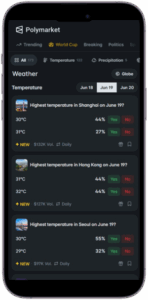
Daily Temperature Contracts
These are the highest-volume contracts in the climate category, and once you understand how they work, it’s not hard to see why.
A market asks something like: “What will the highest temperature in New York City be on June 15, 2026?” You get a set of bracket outcomes (“Greater than 78°F,” “Greater than 80°F,” and so on), and you trade into whichever range you think the official recorded high will fall in.
Single daily temperature markets for major cities regularly clear hundreds of thousands of dollars in 24-hour trading volume. That’s a lot of conviction about the weather.
Monthly Snowfall and Precipitation Contracts
Rather than a single day, these contracts ask whether a city will accumulate above a certain threshold over an entire month. The NYC monthly snowfall contract is one of the most actively traded weather markets on Kalshi, especially during winter.
Speaking as someone who lives in Chicago and has extremely strong feelings about snowfall, I completely understand. Monthly rainfall contracts follow the same structure, with cities like San Francisco generating a lot of activity during wet winter seasons.
These markets reward traders who follow seasonal patterns and study longer-range forecast models rather than chasing day-to-day variability.
Hurricane and Severe Storm Contracts
These markets ask whether a named storm or a storm of a specific category will make landfall within a defined window. With hurricane season running from June through November, both Polymarket and Kalshi offer seasonal and rolling contracts throughout the season.
These attract serious research effort. Traders monitor National Hurricane Center advisories, sea surface temperature data, and long-range atmospheric steering models to form their positions.
It’s one of the more demanding categories to trade well, but it’s also one where genuine meteorological knowledge (or access to people who have it) can translate into real edge.
Tornado Activity Contracts
Tornado contracts break down into numerical brackets for a given 30-day period, something like “More than 150 tornadoes in the US in April.”
Historical tornado frequency data is publicly available and fairly well-understood for someone willing to do the reading, which gives traders who’ve done their homework a reasonable foundation.
These markets tend to see the most activity during spring severe weather season.
Earthquake Frequency Contracts
Weekly and annual contracts on the number of earthquakes above a certain magnitude (typically 6.5 or 7.0) are among the more liquid climate markets on Polymarket. The annual 7.0+ earthquake contract has generated over $1 million in cumulative volume.
These don’t move with daily news the way weather markets do; they’re more about understanding historical frequency distributions and how the current year’s seismic activity is trending relative to baseline.
Annual Climate Ranking Contracts
These are the ones I personally find the most interesting to think about. The question is something like: “Where will 2026 rank among the hottest years on record?” resolving based on NASA’s Global Land-Ocean Temperature Index.
As of late April 2026, the market is pricing about a 56% chance that 2026 finishes second-hottest, and roughly 35% that it takes the all-time top spot.
Trading these requires a very different mindset than daily weather: more climate science, more attention to ENSO cycle data and early-year temperature anomalies, less focus on what the six-hour model run shows. They’re the kind of markets where someone who actually follows climate science can build a legitimate edge over time.
Expert Tips for Climate Prediction Market Trading
Before we get into these, none of what follows guarantees a profit, and every trade in these markets carries real financial risk.
Climate outcomes are uncertain by definition. That’s literally why markets exist around them. These are principles that help you make more informed decisions, not shortcuts to sure wins.
1. Always Read the Contract Resolution Rules Before You Trade
This is the tip I wish someone had actually drilled into me during my first year. Every climate contract resolves based on a specific, named data source: a particular weather station, a specific NOAA report, a defined NASA data table.
Two contracts that look like they’re asking the same question can resolve completely differently depending on which station or dataset they reference.
Where I F*** Up the First Time
I placed a position early on, expecting it to resolve one way based on how I’d read the question. It resolved differently, not because the market was wrong, but because I hadn’t checked how the platform defined the resolution criteria.
The contract used a weather station I hadn’t accounted for, one that records data slightly differently from the forecast tool I’d been using. That was an avoidable, expensive lesson.
Find the Rules or Rules Summary section before you put money in. Every single time.
2. Understand When Forecast Models Update and Watch Them
The real edge in weather trading isn’t necessarily about knowing more meteorology than everyone else. It’s about information timing.
Professional weather models update on roughly six-hour cycles. The market doesn’t always reflect those updates the moment they go live. If you notice a significant model shift that the market pricing hasn’t caught up to yet, that gap is where a potential edge lives.
The National Weather Service publishes free forecast discussions that explain what the models are showing and how confident the forecasters are in the data.
Learning to check those regularly is one of the most practical things you can do if you’re serious about trading daily weather markets.
You don’t need to become a meteorologist. You just need to know where the public information lives and how to read it.
3. Match Your Research Style to Your Contract Type
Daily temperature markets and annual climate ranking contracts require completely different approaches, and treating them the same is a beginner’s mistake.
- Daily markets are all about short-range forecast accuracy. You’re watching model runs, checking recent observations, thinking about day-to-day variability.
- Longer-horizon climate contracts are about bigger-picture trend data, like ENSO cycle phase, where the current year stands against historical baselines, and what climate scientists are saying about temperature anomalies.
Before you enter a market, be honest with yourself about whether you actually have a researched view or whether you’re mostly going on instinct. Both can be valid starting points, but they shouldn’t look the same when it comes to how much you put in.
4. Start Small While You Learn the Mechanics
You can start on most platforms with as little as $10 to $20 and individual positions of $1 to $5. I genuinely recommend doing this for at least your first few months.
The mechanics of how prices move, how early exits work, what bid/ask spreads actually cost you. These make a lot more sense once you’ve traded through them a few times than they do reading about them in a guide.
Small stakes let you learn without a bad outcome being a big deal.
5. Factor Fees Into Your Math Before You Trade
Each platform structures fees differently, and they can meaningfully eat into returns if you’re trading frequently or in small amounts.
Kalshi charges a percentage of trade value. Interactive Brokers ForecastTrader charges a flat $0.01 per contract. OG uses a tiered model based on contract size.
None of these are large in isolation, but if you’re entering and exiting positions regularly, they stack up faster than you might expect. Run the numbers on your expected return before you click buy, not after.
The Technical Edge to Exploit with Climate Predictions
Here’s the part that makes this category genuinely interesting from a trading standpoint: professional weather models update on fixed schedules, roughly every six hours for major systems like the GFS and the European model (ECMWF). The market doesn’t always price in those updates right away.
If you’re watching the forecast data closely and you notice a significant model shift while the market hasn’t caught up yet, that gap between what the science says and what the price reflects is where an informed trader can potentially find an edge.
You’re not betting against the house. You’re trading against other people’s opinions, and opinions don’t always update as fast as the data does.
Resolution is objective and verifiable. On Kalshi, temperature contracts settle based on the final daily climate report issued by the National Weather Service. On Robinhood, many contracts use Weather Underground data from specific airport weather stations.
The resolution source is always spelled out in the contract rules, and I strongly recommend checking it every single time before you trade anything. (I’ll cover this in more detail in the tips section, where I’ll share a mistake I made early on that cost me money in a way that was entirely avoidable.)
| Step | What Happens |
|---|---|
| Browse available markets | Find a climate or weather question you have a view on |
| Buy a contract | Pay between $0.01 and $0.99 per share based on current implied probability |
| Market moves in real time | Prices shift as new forecasts, model runs, and news arrive |
| Hold or sell early | Close your position before resolution for a gain or loss |
| Resolution | Platform checks the official data source and settles the market |
| Payout | Winning shares pay $1.00 each; losing shares pay $0 |
Are Weather Prediction Markets Legal in the US?
Climate prediction markets are federally legal and regulated. But availability in specific states is subject to ongoing legal proceedings, and that picture is still developing.
This section is important to actually read, not because climate prediction markets are in any serious legal jeopardy, but because the regulatory landscape is actively shifting, and where you live affects what you can access.
At the federal level, weather and climate event contracts are regulated by the CFTC as commodity event contracts, not gambling products.
The more complicated piece is at the state level. Several states have pushed back against the idea that CFTC authority preempts their gambling laws, and that’s where things get complicated.
Sports and political event contracts have attracted the most state-level pushback by far, while climate and weather contracts have been relatively less contested, but the legal proceedings affect platform availability broadly regardless of contract type. Stay tuned; things move fast.
Responsible Climate Contract Trading Practices
Keep a few things in mind as you get started:
- Only trade with money you can afford to lose entirely.
- Set a budget for your prediction market activity and stick to it.
- Chasing losses or doubling down on a bad position to “make it back” is how most bad outcomes happen.
- Be especially careful with multi-bracket temperature markets. Buying into multiple outcome brackets might feel like diversification, but you’re still putting more money in total, and only one bracket pays.
If you ever find prediction market trading becoming stressful or compulsive rather than interesting, that’s a sign to step back and reassess. If you or someone you know needs support around problem gambling or financial risk, help is available at 1-800-GAMBLER.
My Opinion on Weather Prediction Markets
I’ve been covering prediction markets for a few years now, and the climate and weather category has become one of my favorites to follow.
Given that I grew up as a Chicago sports fan and have spent decades learning to find meaning in outcomes that don’t go the way I’d hoped, feels like the right fit.
What genuinely sets this category apart is the objectivity of the resolution process. Climate and weather contracts resolve off publicly verifiable data. You can look up the same NWS report or NASA temperature index that your contract will settle against.
There’s no disputed call, no gray area, no “well the committee saw it differently.” The outcome is what the thermometer reads at a specific weather station at a specific time. That level of clean, verifiable resolution is rare in event contract trading.
The other thing I appreciate is that there’s a legitimate research foundation here for anyone who wants to use it. The NWS publishes free forecast discussions. NOAA maintains decades of accessible historical climate data.
Professional model outputs are publicly available. You’re not trading purely on gut feeling. You can actually study this stuff, and the study actually helps.
This category is growing fast, the platforms are investing in it seriously, and the federal regulatory direction is the most favorable it’s been since these markets started to take off.
If you’re curious about getting started, I’d encourage it. Just do it the right way. Start with a small position on a daily temperature market in a city you actually follow, read the contract rules before you trade anything, and treat your first few positions as tuition rather than income.
The opportunity here is real. So is the risk. Both things are true at the same time, and keeping that in mind is what separates the people who enjoy this space long-term from the ones who disappear after one bad weather week.
Trading in prediction markets involves real financial risk. Contract availability, platform access, fees, and legal status may vary by jurisdiction and are subject to change. Always verify current terms directly with the platform before trading. This content is for informational purposes only and does not constitute financial or legal advice.
