If you already know Underdog as the daily fantasy app where half your group chat drafts a Best Ball team every August, here’s the plot twist: the company quietly turned itself into a prediction markets player too.
The product is called Underdog Predict, it launched in September 2025, and it lets you buy and sell yes/no event contracts on real sporting events, plus a handful of non-sports stories, all inside the same app.
I spent real hands-on time on the Predict side of Underdog, placing positions, watching prices move, and trying to break the cash-out feature (more on that later). In this review, I’ll walk you through the bonuses (and who actually qualifies for them), whether it’s legit and legal, what you can trade, the fees, the limits, and how it stacks up against the bigger names.
Underdog Predict Pros and Cons
If you just want the quick read before the deep dive, here’s where I landed after testing it.
| Pros | Cons |
|---|---|
| Prediction markets and fantasy live in one fast, beginner-friendly app | No welcome bonus or promo code for the prediction markets side |
| Simple yes/no trading in plain US dollars, no crypto wallets | Limited deposit options (debit card, Apple Pay, and Trustly only) |
| Low flat fee around $0.02 per contract, with no deposit or withdrawal fees | No public order book or limit orders, so less control for advanced traders |
| Deep, specific sports coverage plus unique Combo entries with fantasy picks | Non-sports markets (politics, economics, culture) are thin |
| Early cash-out through the “Track” tab | Live chat is locked behind a logged-in account |
| Federally regulated via the CFTC, with losses capped at your stake | Not available in every state, and still a young, maturing product |
Underdog Predictions Bonuses and Promos
Underdog runs a well-known welcome offer along the lines of “Play $5, Get $50 in bonus entries” (you’ll sometimes see it advertised as $75, depending on the promo code and the moment).
Here’s the part a lot of pages bury in the small print: that bonus is for Underdog’s fantasy and Pick’em side, not for Underdog Predict. The prediction markets product has no dedicated welcome bonus at the time of writing.
Why the split? Regulation. Prediction market funds sit under a separate federal framework (the CFTC, which I’ll explain below), so your Predict wallet is walled off from your fantasy wallet. You can’t slide fantasy bonus money over to your event contracts, and any bonus you claim on the fantasy side stays put on the fantasy side.
| Offer | Where it applies | Quick notes |
|---|---|---|
| “Play $5, Get $50” bonus entries | Fantasy / Pick’em only | Needs a $10 minimum deposit and a $5 qualifying entry; paid as entries, not cash; typical 1x playthrough; usually 14-day expiry |
| Dedicated Predict welcome bonus | None right now | No prediction-markets sign-up offer as of this writing |
| Predict promo code needed | None | You don’t need a code to start trading event contracts |
What stands out to me is that this is normal for the category. Most CFTC-regulated prediction platforms keep welcome offers small or skip them entirely, partly because regulators frown on aggressive sign-up gimmicks for what is legally a derivatives product.
So while I’d love to point you toward a fat Predict-specific deal, the trustworthy answer is that there isn’t one yet. If that changes, expect Underdog to push it through app notifications, so flip those on if you care.
If you also play daily fantasy, the fantasy welcome offer is worth grabbing on that side of the house. Just don’t expect a single cent of it to reach your event contracts.
Is the Underdog Prediction Market Legit and Safe?
Yes. Underdog Predict runs within a real, federally regulated structure, which is a meaningful step up from the offshore sites that once crowded this corner of the internet. It offers event contracts as a registered FCM (Futures Commission Merchant) through UDM Services, with trades placed on CDNA, the Crypto.com derivatives exchange that the CFTC regulates as a Designated Contract Market.
Translated into plain language, the Commodity Futures Trading Commission, the same federal agency that watches over commodities and derivatives, sits at the top of the chain. Underdog launched its prediction markets in September 2025 after stepping away from its old sports betting positioning, and in early 2026, it picked up its own exchange infrastructure through the Aristotle Exchange acquisition. That’s a company digging in for the long haul, not a fly-by-night operation.
On the safety front, the basics are handled the way you’d expect from a regulated operator. You’ll go through KYC identity verification before you can trade, which keeps the platform compliant, keeps your account yours, and encrypts connections and transactions. One detail I always point out to beginners: your maximum loss on any position is capped at what you paid to enter, plus fees.
Where Is Underdog Predict Legal?
Underdog Predict is live across roughly 30+ US states, including big ones like California, Texas, and Florida. To trade, you have to be at least 18 (or older if your state sets a higher bar) and physically located in an eligible state when you place a position.
That location check runs behind the scenes off your actual GPS, not just the address on your account, so you can’t get around it by traveling on paper. The wrinkle worth knowing is that prediction markets follow their own state map, separate from Underdog’s fantasy availability, so a state where you can play fantasy might still block Predict, and the reverse can happen, too.
The flip side is that, because these are federally regulated event contracts rather than state-by-state sports betting, Underdog Predict can operate in some places where traditional sportsbooks can’t, which is a big part of its appeal. Still, at the time of writing, a few notable states sit on the outside looking in, including New York, Pennsylvania, and Illinois.
The honest reality is that availability in this industry shifts constantly as rules evolve and platforms expand, so don’t treat any list (mine included) as permanent. Underdog has an in-app eligibility check that reads your state in real time, and that’s the source to trust before you fund anything.
Underdog Predict App & Mobile Experience Review
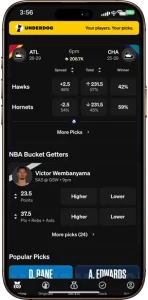
This is where Underdog Predict earns a lot of its goodwill, and it’s the part I came away most impressed by. The Predict Markets live inside the same Underdog app that already pulled in a mountain of high ratings on the fantasy side, so you’re getting a mature, well-tested interface instead of a bolt-on afterthought.
You can trade on iOS, Android, or desktop, but the app is clearly the home base, and the desktop version basically mirrors it with a layout that looks a lot like a sportsbook.
Getting started, the one speed bump is that you have to complete identity verification before the Predict area unlocks. There’s a “Verify Now” prompt in your profile, and until you clear it, the prediction markets header stays greyed out. Correct from a compliance standpoint, mildly annoying if you just want to browse first. Once you’re in, the experience won me over fast.
The Predict section is kept apart from fantasy, so you’re not accidentally drafting a wide receiver when you meant to buy a contract. Tapping into a market hands you the essentials up front, the contract price, your potential payout, and your risk or profit, without forcing you to decode a wall of trading jargon.
The thing I kept testing was the live pricing, and it held up. Prices update in real time, and I watched a few shift mid-session as conditions changed, with no real lag or stutter. For a beginner, that smoothness matters more than people give it credit for, because the second an app feels janky, new traders bail.
My one structural gripe: there’s no public order book. Underdog keeps it simple by letting you buy or sell at the price shown rather than placing limit orders, which is great for newcomers but a little stripped down for power users who live for deep market data.
For the readers I write for, the curious beginner dipping a toe in, that simplicity lands as a plus. For a seasoned exchange trader, it might feel like training wheels.
Markets You Can Trade on Underdog Predict
Underdog Predict sorts the world into two buckets: sports (the obvious star, given the company’s roots) and what it broadly calls culture, which encompasses politics, economics, and entertainment. Here’s how each shakes out.
Sports Event Contracts
Sports prediction markets are the heart of the platform, and where my sports-media brain feels right at home. As of my testing, coverage spanned the NFL, NBA, MLB, NHL, college football, college basketball, soccer, and tennis, with some golf in the mix too. With the 2026 World Cup underway as I write this, the soccer markets have been buzzing, a tidy live example of how trading volume spikes around a marquee tournament.
The real selling point is how specific the sports contracts get. You’re not stuck picking a single championship winner. Here’s the spread of contract types I found:
| Sports contract type | What you’re trading | Example |
|---|---|---|
| Outright winner (moneyline) | A team to win a specific game | “Will the Bears win vs. the Packers?” |
| Spread | Whether a team covers a point/run/puck line | “Panthers -3.5” |
| Game totals | Combined score over or under a set number | “Higher or Lower than 47.5” |
| Player performance | An individual stat line | “QB over/under passing yards” |
| Season win totals | A team’s total wins across a full season | “Cubs to win 84+ games” |
| Championships/futures | Long-term outcomes | “Will Seattle win Super Bowl 2026?” |
Contracts are priced between $0.01 and $0.99, and that price doubles as the market’s implied probability. A contract sitting at $0.70 is the market saying roughly 70% likely. That little mental shortcut is one of the first things I’d want a beginner to get comfortable with.
Politics & Elections
Underdog Predict also carries political prediction markets, covering national outcomes and some local races. During my look around, I came across markets on things like upcoming gubernatorial races. The selection here is thinner than on a politics-first platform like Polymarket, but it’s there if you want to round out your sports trading with the occasional election market.
Economics & Financial Markets
On the economy side, you’ll find contracts tied to business, trade, and macro events, the kind that ask whether the Federal Reserve will cut rates, whether a recession hits by a certain date, or how a specific policy question lands. These reward people who already follow the news closely. Trading activity here tends to be lighter than the headline sports markets, so set expectations accordingly.
Learn more about economy prediction markets and financial prediction markets.
Entertainment & Culture
Rounding out the menu are a mix of entertainment and culture contracts, including award-show outcomes (Oscars, Grammys) and other pop-culture moments. This is the smallest slice of the platform and clearly not the focus. Worth knowing going in: Underdog is a sports house first, and everything else is the side dish.
Underdog Predict Trading Features & Tools

A few tools stood out during testing, and they share the same beginner-first philosophy as the rest of the app.
The headliner is an early cash-out. Because contract prices move in real time, Underdog lets you sell a position before the event settles, so you can lock in a profit or cut a loss instead of riding it to the bitter end. You’ll find this under the app’s “Track” tab, and it worked cleanly when I tried it. One caveat: cash-out is available when the market allows it, so in thinner or fast-closing markets, you may not always get the exit you want at the price you want.
The most distinctive tool is Combo entries, and it’s the kind of thing only a platform with Underdog’s fantasy roots would build. You can string multiple event contracts together into a single entry, and you can even blend a prediction position with up to eight fantasy pick’em selections in one combined “Combo.”
There’s also a multi-team prediction option that lets you stack up to four teams into one entry, across different sports if you want, just not within the same game. It plays like a parlay in the prediction markets world: bigger potential payout, lower odds of hitting. Fun to experiment with, but I’d treat it as a spice, not the main dish, while you’re learning.
The third is the all-in-dollars setup paired with a clear payout display. Everything trades in plain US dollars, with no crypto wallets or token conversions, and each market shows the contract price, your potential return, and your risk in one readable view. If you’ve ever bounced off a more intimidating prediction platform, that combination of dollar-based trading and up-front transparency is a real perk in its own right.
Underdog Predict Trading Strategies & Tips
These aren’t generic “trade smart” platitudes. They’re tuned to how Underdog Predict actually works.
1. Read the contract’s resolution rules before you commit
I’m putting this first because it’s the mistake that bit me early in my days in prediction markets. I once took a position fully expecting it to settle one way, then watched it land the opposite way because I hadn’t checked how the platform defined the outcome.
On Underdog Predicts, every contract is phrased as a specific question with specific settlement criteria. Tap in and read exactly what counts as a “yes” before you buy. Overtime, postponements, and player-out scenarios can all hinge on wording you’d never guess from the headline. Two minutes of reading saves a lot of “wait, what?” later.
2. Use cash-out as a discipline tool, not a panic button
The Track tab makes it tempting to babysit every position and bail at the first wobble. Fight that urge. The smarter move is to decide in advance what a position is worth to you, both a target where you’d happily sell into strength and a floor where you’d cut a loss, then let the cash-out feature carry out your plan instead of your nerves.
Prices swing on injuries, lineup news, and momentum, and having those numbers in mind before kickoff keeps you from dumping a good position into a temporary dip.
3. Respect the Combo math before you stack picks
Those Combo and multi-team entries are good fun, but stacking selections multiplies your risk, not just your upside. Every leg you add lowers the odds the whole thing cashes, the same way a four-leg parlay is far harder to hit than a single pick.
When you’re starting out, I’d keep most of your activity on single positions in the busy markets, where pricing is steadier, and treat Combos as the occasional small-stake swing rather than your bread and butter.
Deposits & Withdrawals at Underdog Predict
Because Underdog Predict is a regulated derivatives product, its payment menu is deliberately leaner than the fantasy side. No credit cards, and Apple Pay only works when it’s linked to a debit card, since financial exchanges generally can’t take credit. One nice surprise: withdrawals open up a few more options than deposits do.
Here’s what I found, though keep in mind these can shift and occasionally vary by state.
| Method | Use | Processing time | Fees (from Underdog) | Minimum |
|---|---|---|---|---|
| Debit card | Deposit | Instant | None | $10 |
| Apple Pay (debit-linked) | Deposit & Withdrawal | Instant deposit | None | $10 |
| Trustly (online banking) | Deposit & Withdrawal | Instant deposit / ~24 to 48 hours to withdraw | None | $10 |
| PayPal | Withdrawal | Within ~48 to 72 hours | None | $10 |
| Venmo / Paysafecard | Withdrawal | Within ~48 to 72 hours | None | $10 |
A few things I appreciated. Deposits land instantly, so you can start trading the moment funds clear. Underdog Predict doesn’t tack on its own deposit or withdrawal fees, though your bank or card issuer might, so check with them. And there’s a small kindness on withdrawals: if your balance dips below the $10 minimum, you can still pull out whatever’s left.
Since the cashier can look different depending on your state and the latest updates, confirm your live options in your account before you rely on a specific method.
Underdog Predict Fees & Trading Costs
This is one of Underdog Predict’s quietly strong points. The fee setup is about as simple as it gets, and for beginners, that predictability is worth a lot.
| Cost type | Amount | Notes |
|---|---|---|
| Per-contract trading fee | Flat $0.02 per contract | Charged once; does not scale with contract price or trade size |
| Deposit fee | None from Underdog | Your bank or card may charge separately |
| Withdrawal fee | None from Underdog | Same caveat as above |
| Pricing spread | Built into buy/sell prices | No public order book, so there’s an implicit cost baked into the shown price |
The flat two cents per contract is the headline, and it’s a one-off charge, not something that comes back to bite you at settlement. A quick example to make it concrete: say you buy 100 contracts priced at $0.36. You pay $36 plus a $2 fee.
If you later sell them at $0.46, you collect $46, leaving roughly $8 of profit after that fee. If you instead hold to settlement and your side wins, each contract pays out $1, so 100 contracts return $100, for a profit of about $62 once you account for your cost and the fee.
The one thing to keep in mind is the missing order book: since you buy and sell at the price Underdog shows rather than naming your own, there’s a small spread tucked into that price.
That’s the trade-off for the simplicity. For casual traders, it’s a fair deal. For high-volume sharps who chase every basis point, it’s something to weigh.
Underdog Predict Trading Limits & Liquidity
The most you can lose on any single position is what you paid to enter it, plus that small per-contract fee. There’s no path to owing more than your stake.
Entry sizes scale with the contract price and how many contracts you buy, and you can add to or trim a position as the market moves, which gives you reasonable flexibility for a platform built around keeping things simple. Underdog also enforces maximum position sizes on each market to stop any single trader from cornering it, though the exact cap varies from market to market.
Liquidity is where I’d set honest expectations. Since Underdog Predict doesn’t display a public order book, you don’t get a transparent view of market depth like you would on a full exchange.
In practice, the popular markets handle this fine. The headline sports contracts, like a primetime NFL game or a live World Cup match, had plenty of activity and steady pricing when I tested.
The quieter markets, some of the politics, economics, and culture contracts, can run thin, which can mean a less favorable entry or a cash-out that isn’t there exactly when you want it. None of that is unusual for a younger, simplified prediction platform, but it’s the kind of detail that separates a market that’s fun to trade from one where you feel a bit stuck.
Stay on the active markets early on, and you’ll rarely bump into it.
My Experience with Customer Support

Underdog Predict keeps support straightforward, with three main avenues: a Help Center, live chat, and email. The Help Center is where I’d send beginners first, because it pulls its weight.
It explains how prediction markets work, breaks things down by specific sports and event types, and answers a lot of the “wait, how does this resolve?” questions before you ever need a human.
For a space this new, having solid self-serve explainers available around the clock is a real plus, and it’s the resource I reached for most while finding my footing.
When you do need a person, live chat is the fastest route once you’re logged in through the account menu, with email as the backup for anything less urgent.
My one real critique, and I think it’s fair, is that live chat requires an active, logged-in account. That means if you’ve got questions before you sign up, the chat door is shut and you’re left with the Help Center or email.
I’d like to see Underdog open up pre-registration chat, since the people with the most questions are usually the ones who haven’t joined yet. Beyond that single rough edge, support did the job for me without any drama.
Responsible Trading at Underdog Prediction Markets
Underdog takes this seriously, and the tools are built into the platform rather than buried three menus deep. You’ll find user-controlled options like deposit limits, entry limits, and session timeouts, the standard responsible-play kit, alongside clear risk disclosures threaded through the app and its marketing.
The structural safety net I mentioned earlier matters here too: capping your maximum loss at your entry cost is a real guardrail against the runaway losses that can happen in less careful corners of trading. The overall feel is what you’d want from a regulated operator, practical self-serve controls and plain messaging instead of making you call support to beg for a limit.
That said, tools only help if you use them. Prediction markets can feel like a fun puzzle, and that’s exactly what makes it easy to overdo. My standing advice, on Underdog or anywhere:
- Set your deposit limit before your first trade, not after a rough week.
- Treat your trading budget like money that’s already spent on entertainment, because any of it can vanish.
- And if it ever stops feeling like a hobby and starts feeling like a way to fix something, step back and use the time-out features, or reach out for help.
Disciplined and informed beats fast and reckless every time. That’s not me being preachy. It’s the single clearest difference I’ve seen between people who enjoy this space for years and people who flame out.
Underdog Predict vs Other Prediction Markets
Underdog Predict isn’t trying to be all things to all people, and lining it up against the bigger names makes its lane clear.
Underdog Predict vs Kalshi
Kalshi is the elder statesman of US regulated prediction markets, running a true exchange with a visible order book, deeper liquidity, and a famously wide menu that spans politics, economics, weather, and culture alongside sports. If you want depth, range, and the ability to set your own prices, Kalshi wins.
Underdog’s answer is simplicity and a sports-first identity: an easier interface, dollar-based trading, and some of the most specific sports contracts of the two. For a beginner who mostly cares about sports and wants the least intimidating on-ramp, Underdog is the friendlier door. For a trader who wants breadth and control, Kalshi pulls ahead.
Underdog Predict vs Polymarket
Polymarket is the heavyweight for sheer variety and volume, especially on politics, where its markets dwarf almost everyone else’s. It’s the place for deep, wide-ranging real-world contracts. The trade-offs are a steeper learning curve and a crypto-flavored experience that can feel foreign to US newcomers.
Underdog flips that script with a US-dollar app, no wallets to manage, and a tight focus on sports rather than a thousand niche global markets. If your interests run political and you want the broadest possible board, go to Polymarket, and if you want sports in a friendly app with no crypto layer, choose Underdog.
Underdog Predict vs PrizePicks Predict
This is the most apples-to-apples matchup, and the one sports fans should pay attention to, because PrizePicks Predict is the other daily-fantasy giant that pivoted into prediction markets. Both are chasing the same sports-loving, pick’em-native crowd. The flavors differ, though. PrizePicks Predict (which runs peer-to-peer on Kalshi’s infrastructure, with Team Picks and Culture Picks) leans hard into player-stat contracts, turning individual performances into simplified yes/no positions.
Underdog casts a slightly wider net across full game outcomes, spreads, totals, and futures, not just player stats, and its Combo entries let you blend contracts with fantasy picks in a way PrizePicks doesn’t quite mirror.
- If your whole game is “will this player go over or under,” PrizePicks Predict speaks your language.
- If you want to trade game winners, spreads, and season storylines alongside player props, Underdog gives you more angles.
Either way, compare the exact markets and your state’s eligibility on both before you commit, since that’s where the day-to-day difference actually shows up.
My Final Words on Underdog Predict
Underdog Predict is one of the most welcoming ways to step into regulated sports prediction markets right now. The app is mature and easy to read, the fees are simple and cheap at a flat two cents per contract, the all-dollars setup kills the crypto learning curve, and the sports coverage is impressively detailed for a product barely a year old.
It stands on a solid regulatory footing through the CFTC framework, and small touches like the capped-loss structure, the clean cash-out tool, and the fantasy-style Combo entries show a platform built with sports fans in mind. If you’re curious about trading event contracts and you want the least intimidating front door in the category, this is a strong pick.
It’s not flawless, and I’d be selling you short to pretend otherwise. There’s no dedicated welcome bonus for the prediction markets product, the non-sports markets are thin and clearly an afterthought, the absence of a public order book limits transparency and depth, and locking pre-registration users out of live chat is a small but real annoyance. It’s also a young product still finding its feet, so expect things to keep changing. None of that is a dealbreaker for the audience I write for, but it’s the full picture.
Start with a small, comfortable amount, stay on the busy sports markets while you learn the ropes, read every contract before you buy, and let your own experience be the tiebreaker. As always, the win isn’t one lucky payout. It’s understanding the market well enough to make your own smart calls.
Underdog Predictions Trading FAQs
Yes. Underdog Predict is a legitimate, federally regulated platform that offers event contracts through CDNA, a CFTC-regulated exchange, with identity verification and encryption in place. Your maximum loss is capped at your entry cost plus fees. As with any trading product, you can still lose money on a wrong call.
Underdog Predict lets you buy and sell yes/no event contracts on real-world outcomes, mostly sports. Each contract is priced between $0.01 and $0.99, which reflects the market’s implied probability. If your prediction is correct, the contract settles at $1; if it’s wrong, it settles at $0.
No. Underdog Predict has no dedicated welcome bonus or promo code at the time of writing. The well-known “Play $5, Get $50” offer applies only to Underdog’s fantasy and Pick’em contests, and those bonus funds cannot be used on prediction market event contracts.
Underdog Predict is available in roughly 30-plus US states, including California, Texas, and Florida, for users 18 and older. It isn’t available everywhere, with states like New York, Pennsylvania, and Illinois excluded at the time of writing. Always confirm your state in the in-app eligibility tool.
Underdog Predict charges a small flat fee of about $0.02 per contract, applied once when you buy. There are no deposit or withdrawal fees from Underdog, though your bank may add its own. A small spread is also built into the displayed buy and sell prices.
Yes. Underdog Predict lets you sell a position early through the app’s “Track” tab, before the event settles, to lock in a profit or cut a loss. Early cash-out is available when the market allows it, so on thin or fast-closing markets it may not always be offered.
This review reflects Underdog Predict as observed at the time of writing. Platform availability, fees, payment methods, market offerings, and promotions can change and vary by state, so always verify the current details in the app before you trade. Prediction markets carry real financial risk, and you can lose money. Trade responsibly and only with funds you can afford to lose.
