
Our Kalshi review breaks down what Kalshi is, how it works, what it costs to trade, where it’s available, and how it stacks up against the growing pack of competitors.
Everything you need to make an informed decision, whether you’re curious about prediction markets for the first time or looking to pick the right platform to start trading seriously.
After hands-on testing across multiple market categories, I’ll show you how fees affect profits, how liquidity and timing influence trade value, and whether the welcome bonus and market selection justify signing up.
Kalshi is the most established regulated prediction market in the US, with a massive catalog of markets, a clean mobile app, and strong consumer protections. But there are a few things worth knowing before you fund your account, and that’s our goal with this page. Read on to learn everything you need to know!
What is Kalshi? A Practical Overview

Kalshi is a federally regulated event contract market where you trade on the outcomes of real-world events using real US dollars.
You trade Yes/No event contracts on real-world outcomes, priced between 1 and 99 cents to reflect the market’s collective probability estimate. A contract at 70¢ means traders collectively think there’s a 70% chance the event happens.
If you’re right at resolution, you collect $1 per contract. If not, you lose what you put in. You can also exit positions before resolution as prices shift.
The back story
Most trading platforms are built the same way: ship the product, find the users, deal with regulators later. Kalshi did the opposite, and that decision is the most important thing to understand about it.
When co-founders Tarek Mansour and Luana Lopes Lara started the company in 2018, they spent two and a half years building the exchange, a brokerage infrastructure, and a federal-grade market surveillance system before a single user ever placed a trade.
The trigger, according to the founders’ own background, was watching events like the Brexit referendum send markets into chaos with no way to hedge against the event itself directly. You could trade assets affected by Brexit, but not Brexit. That gap is what they set out to close.

In November 2020, the CFTC approved Kalshi as a Designated Contract Market (DCM), the same regulatory framework governing major U.S. futures exchanges. The platform launched publicly in July 2021.
That regulatory-first approach is why Kalshi sits in a different category from every other prediction market you’ll come across: your funds are held in segregated accounts, every listed market has been cleared under federal derivatives law, and there’s an actual government agency with enforcement authority overseeing operations.
CEO Tarek Mansour has described the long-term vision as wanting to “financialize everything and create a tradeable asset out of any difference in opinion.” That’s not marketing fluff. It tells you exactly what kind of platform this is: a regulated exchange where collective knowledge about any verifiable future outcome becomes something you can trade on.
How Does Kalshi Work?
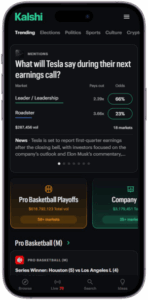
In Kalshi you’re buying a “Yes” or “No” contract tied to a specific question, like “Will the Fed raise interest rates this quarter?” or “Will the Kansas City Chiefs win the Super Bowl?”
Here’s the simple version of how it works step by step:
- A market gets created: Kalshi (or its users) proposes a question about a future event. That question becomes an open market.
- You pick a side: You buy either a “Yes” contract (you think it will happen) or a “No” contract (you think it won’t).
- The price reflects probability: Contract prices run from $0.01 to $0.99, and they work like a crowd-sourced probability. If a “Yes” contract is priced at $0.70, the market is collectively saying there’s roughly a 70% chance that outcome occurs.
- The market settles: Once the event plays out and the outcome is confirmed, winning contracts pay out $1.00 each. If your contract loses, you lose what you paid for them.
To put it in real practical numbers: say you buy 10 “Yes” contracts at $0.60 each for a total of $6.00. If your prediction is correct, each contract settles at $1.00 and you collect $10.00, a $4.00 profit before fees. If you’re wrong, you lose your $6.00 stake.
Kalshi Promo Code & Bonuses
Kalshi doesn’t offer a traditional welcome bonus the way sportsbooks and other platforms do. There’s no deposit match, no free bet credit, and no guaranteed sign-up offer waiting for every new user. What Kalshi does officially offer, confirmed directly through its Help Center, are two programs worth knowing about.
Kalshi Referral Bonuses
The first is a referral program. If an existing Kalshi user shares their personal referral link with you and you sign up through it, you both receive $25 in trading credit once you complete the required trading activity. The referral code can be entered during sign-up or within 72 hours of creating your account, but only before your first deposit. You can check your specific trading requirements in the Rewards section of the app after signing up.
Kalshi’s Incentive Program
The second is the Volume Incentive Program, a cashback rewards system running from September 15, 2025 through September 1, 2026. It pays you a share of a reward pool based on how much you trade during active reward periods. For example, if the pool is $1,000 and you contributed 10% of total eligible volume, you earn $100. There’s a cap of $0.005 per contract traded, so maximum earnings scale with activity rather than a fixed payout.
Both programs are available to verified U.S. members. Market makers with existing agreements, Kalshi affiliates and employees, and international users are not eligible.
Kalshi Bonus Terms & Conditions
- Referral credits are trading credits, not withdrawable cash. Only profits earned from using those credits can be withdrawn.
- You must be fully KYC-verified to receive referral or incentive rewards.
- Referral codes must be entered during sign-up or within 72 hours and before your first deposit. After that window, codes cannot be applied manually.
- Volume Incentive Program rewards are capped at $0.005 per contract traded per period. Only contracts priced between $0.03 and $0.97 are eligible.
- Kalshi can modify or end either program at any time. Always check help.kalshi.com for current terms before signing up.
How To Create an Account on Kalshi
Getting started on Kalshi takes less than 10 minutes in most cases. Here’s how it works.
Step 1: Visit Kalshi.com and Sign Up
Go to kalshi.com and create your account using your email address, or sign up via Google or Apple. If you have a referral code from an existing Kalshi user, this is the step to enter it.
Step 2: Complete Identity Verification (KYC)
Complete KYC verification (required by CFTC regulations): provide your name, address, date of birth, Social Security number, and government ID upload. Verification typically completes within minutes to 24 hours. This step is non-negotiable since Kalshi operates as a regulated financial exchange, not an anonymous platform.
Step 3: Fund Your Account
Fund your account via free ACH bank transfer (no fees, 1-3 business days) or instant debit card deposit (small fee, immediate). No minimum deposit requirement is enforced, though starting with $50-100 is recommended for meaningful position sizes.
Step 4: Explore the Markets
Browse the different market categories, including sports, economics, politics, climate, and culture. Each market shows the current Yes/No prices, total trading volume, and settlement date. Take some time here to understand the contract pricing before committing real money.
Step 5: Place Your First Trade
Select a market, choose Yes or No based on your view of the outcome, enter the number of contracts you want to buy, and confirm your order. You can also sell your position at any time before the event resolves, allowing you to lock in profits or cut losses based on how contract prices move.
Is Kalshi Legit and Safe?
Yes, Kalshi is a legitimate and regulated platform. That said, “legit” and “risk-free” are two different things, and it’s worth being clear on both.
On the regulatory side, Kalshi took a path that very few prediction platforms were willing to attempt. It went to the CFTC and requested approval to operate as a regulated exchange, which required meeting the same core principles that govern longstanding derivatives markets: financial safeguarding, surveillance standards, trade reporting, rulebook compliance, and protections designed to prevent manipulation.
Kalshi keeps all customer money in special bank accounts that are separate from the company’s own money. This means your funds are protected and can’t be used for Kalshi’s business costs.
The platform uses KYC verification and encryption for all accounts. Trades are handled through Kalshi’s own CFTC-regulated clearing house, and you can benefit from improved security, including the use of facial or fingerprint recognition on the mobile app.
What stands out to me is the transparency around market resolution. Kalshi publishes resolution sources for every market so you know in advance how outcomes will be determined. When ambiguous situations arise (like a halftime show performance during the Super Bowl), Kalshi may convene an outcome review committee to determine the final market outcome. If the outcome is ambiguous, Kalshi may settle the market at the last traded price.
One thing worth being direct about: all prediction market trading involves the possibility of losing money. Contracts settle at $1 or $0, so a trade that goes against you means losing your full position. Never trade more than you are comfortable losing.
Where Is Kalshi Legal?
Kalshi’s legal status in the U.S. is a genuinely evolving situation, and it’s important to understand the distinction between its federal authorization and the ongoing state-level disputes.
At the federal level, Kalshi is regulated by the CFTC and is licensed as a Designated Contract Market (DCM), which makes it legal at the federal level and allows it to operate across all states.
However, sports-related markets have triggered legal pushback from several state regulators. Eight states have issued cease-and-desist letters to Kalshi: Nevada, New Jersey, Maryland, Ohio, Illinois, Montana, Arizona, and New York. Each state claims Kalshi operates as illegal sports betting without proper licensing.
Court outcomes have been mixed. A Philadelphia-based court’s three-judge panel determined that authority over Kalshi’s contracts rests exclusively with the CFTC. In a significant ruling issued in early April 2026, a federal appeals court held that New Jersey cannot impose state gaming regulations on Kalshi’s platform. At the same time, a Massachusetts Superior Court judge issued a preliminary injunction against Kalshi, effectively banning the platform from offering sports-based contracts within the state.
In practical terms, the table below reflects the current general landscape for Kalshi access. Given how fast this regulatory picture is moving, always verify your state’s current status before signing up.
| Status Category | States/Notes |
|---|---|
| Generally accessible (federal DCM status) | Most U.S. states including CA, TX, FL, and 40+ others |
| Sports markets geofenced or restricted | Massachusetts (sports contracts blocked by court order) |
| Active legal disputes (status may change) | Nevada, Maryland, Ohio, New York, others |
| Cease-and-desist issued (varying court outcomes) | AZ, CT, IL, MT, NJ (NJ injunction overturned at appeals level) |
Political and economic markets have faced far less legal resistance than sports markets and are broadly available across the country.
Kalshi App & Mobile Experience Review
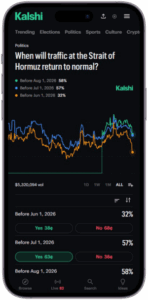
Kalshi offers dedicated apps for both iOS and Android, and in my view, the mobile experience is one of the platform’s real strengths.
The Android version of the app has a 4.5-star rating from 3,000+ reviews and an impressive 500,000 downloads. Reviews comment on the quality of the app itself and its smooth user interface, plus the diversity of the prediction markets the app supports. The iOS version of the app has an even higher rating of 4.7 from 22,000+ reviews.
The app gives you full access to every feature available on the desktop platform. You can deposit and withdraw funds, browse and filter markets, place market or limit orders, monitor active positions in real time, and receive push notifications when prices move or markets resolve.
In some markets, timely trading is essential. If you’re someone who likes to react to the platform’s “Breaking” and “Trending” markets, the app puts these features at your fingertips, wherever you happen to be.
The layout is clean and beginner-friendly. Markets are organized by category, each showing the current Yes/No price, volume, and expiration date at a glance. The trade execution flow takes just a few taps. There’s also biometric login support on compatible devices.
One area worth noting: since October 2025’s most recent outage reports, Kalshi has really ramped up its bug fixes and performance upgrades. The platform has improved meaningfully on the stability front, though it’s worth checking recent user reviews for your specific device before downloading.
App Summary
| Feature | Details |
|---|---|
| iOS Rating | 4.7/5 (22,000+ reviews) |
| Android Rating | 4.5/5 (3,000+ reviews) |
| Available On | App Store, Google Play |
| Full Desktop Parity | Yes |
| Push Notifications | Yes |
| Biometric Login | Yes (Face ID / Fingerprint) |
| Deposit/Withdraw In-App | Yes |
Markets You Can Trade on Kalshi
Kalshi lists over 350,000 active markets across sports, politics, economics, and crypto. Sports now account for roughly 90% of its trading volume, a shift that accelerated sharply with the 2025-26 NFL season. Here’s a breakdown of each major category.
Sports Markets
Sports prediction markets are by far the most active category on Kalshi right now, with thousands of contracts across 17 different sports. Markets go well beyond simple game outcomes, covering spreads, totals, player props, and parlays through the Build Your Combo feature.
Major events like the NFL season, NBA playoffs, college football, golf majors, and the Masters generate particularly high volume. Sports markets are subject to state-level legal disputes in some jurisdictions (see the legality section above).
Political & Election Markets
Kalshi’s political prediction markets are among the most liquid non-sports markets on the exchange, especially during election cycles.
Markets cover U.S. congressional control, presidential races, gubernatorial elections, and policy outcomes. Worth noting: prediction markets called the 2024 U.S. presidential election correctly for a Trump win at a time when most polls were still showing a toss-up, which did a lot to bring these platforms into mainstream credibility.
Economic & Financial Markets
Economic and financial markets are where Kalshi’s catalog runs deeper than any sports-focused platform. Economic markets include Fed interest rates, inflation (CPI), GDP, recession, gas prices, and mortgage rates. Financial markets cover daily S&P 500, Nasdaq 100, and WTI oil.
These markets attract traders with genuine economic knowledge, including professionals who understand what a CPI print or Fed rate decision actually means. Notably, Kalshi’s S&P 500 and Nasdaq-100 markets use a halved fee multiplier, cutting trading costs by 50% compared to standard markets.
Climate & Weather Markets
Weather prediction markets cover hurricane strength, daily city temperatures, and tornado numbers. These are genuinely unique markets that you won’t find at any traditional sportsbook. They attract meteorologists and weather enthusiasts who can apply specialized knowledge for an edge.
Culture & Entertainment Markets
Culture markets include Billboard 100, Oscars, Grammys, Emmys, and #1 Hits. Kalshi sticks to measurable, verifiable outcomes here. You won’t find speculative celebrity gossip markets, but you will find contract questions like “Who wins Best Picture?” or “Will a specific song hit #1 on Spotify this month?”
Crypto & Tech Markets
Kalshi offers markets tied to cryptocurrency prices (Bitcoin, Ethereum) and technology events such as SpaceX launches and product release milestones. These markets tend to move quickly when major news breaks, making them popular for short-term traders.
Mention Markets
Kalshi launched mention markets in fall 2025, which let users trade on whether specific words or phrases will appear in speeches, press conferences, or social media posts. These have since grown to volumes comparable to smaller sporting events. Trump mention markets have been particularly popular.
Kalshi Trading Features & Tools
The trading experience on Kalshi is more layered than the Yes/No interface suggests. Here’s what’s actually under the hood:
Order Book & Limit Orders: Kalshi operates a live order book, meaning you can place market orders (executed immediately at the current price) or limit orders (executed only when the market reaches your desired price). Limit orders are especially useful for getting better prices and, importantly, come with lower maker fees.
Build Your Combo (Parlays): Kalshi introduced combos in 2025, which mimic parlays. This lets you chain multiple independent event contracts together for a higher combined payout, similar to how a parlay works in sports betting.
Mention Markets: A newer format where you trade on whether specific words or phrases appear in public statements, broadcasts, or posts.
Trending & Breaking Markets: The platform highlights markets with surging volume and newly listed events in real time, so you don’t have to hunt for what’s moving.
Kalshi Research: Kalshi launched Kalshi Research in late 2025 for academic insights into market accuracy, which often outperforms traditional forecasts during volatile events.
API Access: Kalshi offers a free public API, making the platform accessible to developers who want to build tools, bots, or automated strategies on top of the exchange’s data.
TradingView Integration: Advanced chart-style analysis is available for traders who want to track price history and volume trends across markets.
Kalshi Fees & Trading Costs
Understanding Kalshi’s fee structure is important before you start trading because the costs are not flat and vary depending on how you trade and how you fund your account.
Trading Fees
Kalshi’s fee formula is: 0.07 × contracts × price × (1 − price), capped at $1.75 per 100 contracts for takers and $0.44 for makers. Because price appears as P × (1-P) in the formula, fees are highest on contracts priced near $0.50 and lowest near the extremes.
In plain terms: the closer a contract is to 50/50, the more you pay in fees. Contracts trading near 1¢ or 99¢ (high or low confidence) have very low fees.
There are two types of trading fees:
- Taker fees: Charged when you buy or sell contracts at the current market price (a market order). Fees apply immediately when your order fills.
- Maker fees: Charged when you place a limit order that sits on the order book before being matched. Maker fees are lower than taker fees, and there’s no charge for canceling a resting order that never gets filled.
Trading fees on Kalshi are typically less than 2% per contract. As an example, the fee for a $100 trade is capped at $1.74.
Deposit & Withdrawal Fees
| Payment Method | Deposit Fee | Withdrawal Fee | Processing Time |
|---|---|---|---|
| ACH Bank Transfer | Free | Free | 1-3 business days (deposit), 3-4 business days (withdrawal) |
| Wire Transfer | Free (bank may charge) | Free (bank may charge) | Faster than ACH once sent |
| Debit Card | 2% | $2 flat fee | Instant (deposit), faster (withdrawal) |
| PayPal / Venmo | No Kalshi fee | Verify with provider | Varies |
| Crypto (via ZeroHash) | Network fees apply | Network fees apply | Varies by blockchain |
No settlement fees are charged once contracts resolve. Your winnings are credited to your Kalshi balance at $1 per winning contract.ng at the current price.
Kalshi Trading Limits & Liquidity
On minimums, Kalshi’s help center notes a $10 minimum for bank transfers. Debit card and other methods have no stated floor, so you can technically start with a single contract.
For position sizing, the minimum trade is effectively one contract, which could cost as little as $0.01 for a 1¢ contract. There are maximum position limits per market, which vary by event and are set to prevent manipulation and maintain market integrity.
On the liquidity side, Kalshi has become a genuinely deep market for major events. Combined, Kalshi and Polymarket produced $1.63 billion across Super Bowl 60 markets, the largest event window in prediction market history, with Super Bowl Sunday alone generating approximately $1.34 billion, the single largest trading day on record.
For smaller or more obscure markets, spreads can widen and liquidity may be thinner, which is worth keeping in mind if you’re trying to enter or exit a large position. Major sports, elections, and economic data releases will always offer the best execution quality.
Kalshi Trading Strategies & Tips
Prediction markets reward genuine knowledge and disciplined thinking. Here are three actionable approaches that work specifically well on Kalshi.
1. Use Limit Orders to Save on Fees
One of the most underrated cost-saving moves on Kalshi is simply placing limit orders instead of market orders. As covered in the fees section, maker fees are meaningfully lower than taker fees.
If you’re not in a rush to execute, set your price slightly better than the current ask and let the market come to you. This is especially valuable when trading near the 50¢ range, where taker fees peak.
2. Focus on Categories Where You Have an Informational Edge
Kalshi’s market catalog spans economics, weather, sports, and culture. The markets that offer the best opportunity are the ones where you genuinely know more than the average trader.
An economist tracking Fed signals will have a real edge on interest rate markets. A sports statistician will do better on player prop contracts. Avoid the temptation to trade every category just because the interface makes it easy.
3. Watch for Mispriced Contracts After Breaking News
Kalshi’s order-book model means prices update in real time as traders react to new information. Contract prices tend to become more accurate as the contract expiry date is approached.
This means early in a market’s life, pricing can be less efficient. If you follow a news category closely and can react quickly when relevant news breaks, there can be a window to find contracts that haven’t yet adjusted to new information. The Trending and Breaking market tabs in the app are useful for spotting these moments.
Kalshi vs Other Prediction Markets
Here’s how Kalshi compares to other top prediction market platforms.
Kalshi vs Polymarket
Kalshi and Polymarket currently split the market roughly 53/47. These are the two dominant U.S. prediction platforms, but they were built on different foundations.
Kalshi is a dollar-in, dollar-out platform: you fund with USD, trade in USD, withdraw in USD. No crypto wallet required. Polymarket is a decentralized prediction market built on the Polygon blockchain where users trade using USDC.
On fees, Polymarket’s U.S. product has a flat 0.10% taker fee, which is lower than Kalshi’s formula-based fees for mid-range contracts. However, Kalshi is easier to understand at a glance and doesn’t require crypto knowledge.
On market range, Kalshi currently offers broader immediate access, while Polymarket’s U.S. product launched in early 2026 with a limited selection still rolling out via a waitlist. The global version of Polymarket also lists markets that regulated U.S. exchanges like Kalshi cannot, such as geopolitical and conflict-related events.
Best for: Kalshi works better for U.S. traders who want regulatory clarity, no crypto, and broad market access right now. Polymarket appeals to crypto-native users and those wanting the lowest possible fees.
Kalshi vs Robinhood Prediction Markets
Robinhood’s prediction markets hub is powered by Kalshi under the hood. Since launching in March 2025, it has brought event trading to Robinhood’s user base through an integrated interface and seamless deposits.
If you’re already a Robinhood user, you can access Kalshi markets directly within the Robinhood app, which makes for a convenient unified experience. Trading directly on Kalshi.com, however, gives you access to the full market catalog and more advanced tooling.
Best for: Robinhood is a solid entry point if you already use the app. Trade directly on Kalshi for the full experience and maximum market selection.
Kalshi vs Fanatics Market
Fanatics Market is a sports-first prediction platform backed by the Fanatics brand, the same company behind licensed sports merchandise and retail. It offers event contracts on sports and entertainment outcomes with a simplified trading experience aimed at casual fans rather than active traders.
Fanatics Market is sports-first and is likely to feel familiar to fans already embedded in the Fanatics ecosystem. However, it currently lacks the breadth of Kalshi’s non-sports markets (economics, climate, culture, politics), and its trading volume and liquidity are much smaller.
Fanatics’ reach and existing sports audience give it long-term potential as prediction-style products gain wider acceptance. For now though, it’s a narrower product compared to Kalshi.
Best for: Fanatics suits casual sports fans who are already in the Fanatics ecosystem. Kalshi is the better fit for anyone who wants a broader prediction market experience beyond sports.
Kalshi Payment Methods: Deposits & Withdrawals
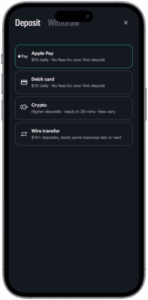
Kalshi supports a range of deposit and withdrawal methods to suit most U.S. traders. ACH bank transfer is the most cost-efficient option, with no fees on either end and a typical processing time of 1-3 business days for deposits.
Wire transfers suit larger amounts and process faster once sent. Debit cards, Apple Pay, and Google Pay offer instant funding but carry a 2% fee.
Any crypto deposited through partner ZeroHash is converted to USD upon arrival. You are not holding a crypto balance on Kalshi. Everything converts to USD at the point of deposit.
PayPal and Venmo are available for U.S. users only, and the account name must match your Kalshi account exactly.
For withdrawals, Kalshi applies security hold periods based on your deposit method. Debit card deposits are usually available for withdrawal after about 3 days.
Bank transfers from the same bank typically require about 7 days, and transfers from a different bank may require up to 30 days. These holds are standard for regulated financial platforms and exist to protect against fraud and chargebacks.
| Method | Deposit Fee | Withdrawal Fee | Notes |
|---|---|---|---|
| ACH Bank Transfer | Free | Free | 1-3 business day deposit, 3-4 day withdrawal |
| Wire Transfer | Free | Free (bank may charge) | Best for larger amounts |
| Debit Card (Visa/MC) | 2% | $2 flat | Instant deposit |
| Apple Pay / Google Pay | 2% | N/A | Instant, deposit only |
| PayPal | No Kalshi fee | No Kalshi fee | U.S. only, name must match account |
| Venmo | No Kalshi fee | No Kalshi fee | U.S. only, name must match account |
| Crypto (via ZeroHash) | Network fees | Network fees | Converts to USD on arrival |
Customer Support & Help Center
Kalshi’s primary support channel is its in-app and on-site chat messenger. The fastest way to get help is through the messenger (chat icon in the bottom right corner) while logged in to your Kalshi account. This lets the team pull up your account details automatically and resolve things faster.
You can also reach Kalshi by email at [email protected]. For legal inquiries, [email protected] is the appropriate contact. The Kalshi phone number is (332) 205-9910. The headquarters is located at 594 Broadway, Suite 407, New York, NY 10012.
Kalshi also operates an official Discord community where they discuss market ideas, answer questions, and provide a space for developers to discuss Kalshi’s API. This is especially useful for traders who want to engage with the broader community or get faster informal responses on market-related questions.
The Help Center at help.kalshi.com includes organized articles on account setup, trading basics, deposits and withdrawals, fees, and KYC requirements.
One area where Kalshi has received criticism in user reviews is response times for complex account issues, particularly related to withdrawals and account access. Based on user feedback patterns, straightforward questions tend to get resolved quickly through chat, while account recovery and payment issues can take longer.
Tip: If you run into a withdrawal problem, I’d recommend going through the in-app messenger first (since it connects to your account details automatically) before trying email.
PredictGeek’s Final Words on Kalshi
If you’re new to prediction markets, Kalshi is the best place to start in the U.S. It’s accessible, well-documented, and governed by real financial regulations rather than a terms-of-service that could change overnight. If you’re a more experienced trader, Kalshi offers enough depth, liquidity, and tooling to grow with.
It gets a lot right. No crypto required, clean design, over 350,000 active markets, CFTC oversight, and a legitimate legal foundation that competitors have spent years trying to match.
What stands out the most is the combination of market breadth and regulatory clarity. Whether you want to trade on the Fed’s next interest rate decision, a Super Bowl outcome, or who wins Best Picture at the Oscars, it’s all in one place, all priced in U.S. dollars, and all under a federal regulatory framework.
That said, there are real limitations to be aware of. Sports markets are operating in legal limbo in a handful of states due to ongoing litigation, so your access may vary. Trading fees are higher than some newer competitors when you’re trading near the 50 cents range.
Customer support quality based on user reviews is inconsistent for more complex issues. And prediction markets in general carry real financial risk, so this is not a place to put money you can’t afford to lose.
Kalshi Prediction Market FAQs
Kalshi is the first federally regulated prediction market in the U.S., licensed by the CFTC as a Designated Contract Market. You trade Yes/No event contracts on real-world outcomes, from sports and elections to economic data and entertainment, all priced in U.S. dollars with no crypto required.
Yes, Kalshi is federally legal and regulated by the CFTC. It is accessible in most U.S. states. Sports-related markets are subject to ongoing legal disputes in a small number of states, including Massachusetts, where they have been geofenced. Always check your state’s current status before trading.
No. Kalshi is only available to US residents and requires US identity verification. Using a VPN to access it from abroad violates the terms and can lead to suspension.
Kalshi makes money through transaction fees on trades. It uses a maker-taker fee model and publishes its full fee schedule publicly.
The main risks are price volatility and low liquidity. Prices can move quickly on news, and thin markets can make it harder to enter or exit trades at good prices.
Liquidity refers to how easily you can buy or sell contracts without affecting the price. Higher liquidity means tighter spreads and faster fills; low liquidity means higher trading costs.
Kalshi is regulated by the CFTC and follows rules on customer fund segregation. While your funds are protected at the platform level, trading outcomes still depend on your decisions.
Withdrawals use the same methods as deposits. ACH transfers are free and take 2–5 business days, while debit cards and wires are faster but include fees. KYC is required.
Yes. Kalshi has mobile apps for iOS and Android that let you trade, monitor positions, and manage your account on the go.
You can trade very small amounts. Contracts are priced between $0.01 and $0.99, so positions can cost just a few dollars.
Yes. Every contract has a settlement date. Winning contracts settle at $1.00, losing ones at $0.00, and you can exit trades before settlement.
No. Using a VPN to bypass location restrictions violates Kalshi’s terms and can result in account suspension or loss of access.
No demo account is available. However, low trade minimums let you practice with small amounts of real money to learn how the platform works.
