AI prediction markets let you trade on questions like which lab will have the top-ranked model at the end of the month, when OpenAI ships its next big release, or whether a hot AI company goes public before a deadline. Instead of arguing about it in a group chat, you buy a Yes or No contract and let the market settle the argument.
I’ve been trading event contracts since 2021, and for a long time my comfort zone was sports. The AI board pulled me in for a different reason: there’s no injury report, no weather delay, and no Bears secondary to blame. It’s a strange mix of tech news, leaderboard math, and rule reading, and it has taught me more about contract fine print than any NFL Sunday ever did.
This page is part of our broader guide to prediction markets, and it covers how AI event contracts work, which apps list them, how they resolve, and the mistakes I made so you can skip them.
What Is an AI Prediction Market?
An AI prediction market is a set of Yes/No event contracts tied to artificial intelligence outcomes, like which company has the top-ranked model, when a new model launches, or when an AI company goes public. Each contract pays $1 if the event happens and $0 if it doesn’t, so its price works like a live probability.
In plain English, a contract trading at 30¢ means traders, as a group, see roughly a 30% chance of that outcome. If you think the real chance is higher, you buy Yes. If you think it’s lower, you buy No.
How AI Prediction Markets Work
Every AI contract has three parts I check before I trade: the question, the resolution source, and the check time. The question tells you what you’re betting on, the source tells you who decides, and the check time tells you exactly when the snapshot is taken.
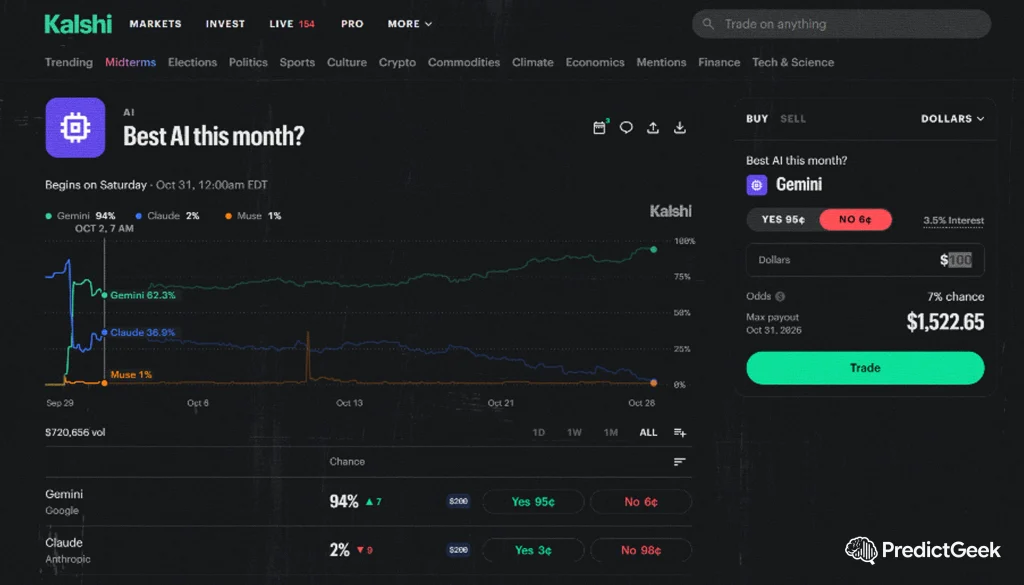
Here’s a simple example. Say a “Which company has the best AI model at the end of the month?” market prices Google at 71¢. You buy 50 Yes contracts for $35.50. If a Google model sits at #1 on the specified leaderboard at the check time, your 50 contracts pay $50. If anyone else is on top, they pay nothing.
| Scenario | Cost | Payout | Profit or loss (before fees) |
|---|---|---|---|
| Google is #1 at the check time | $35.50 | $50.00 | +$14.50 |
| Another company is #1 | $35.50 | $0.00 | -$35.50 |
| You sell early at 80¢ | $35.50 | $40.00 | +$4.50 |
That last row is the part beginners often miss. You don’t have to hold until settlement. If a surprise model release moves the price in your favor (or against you), you can sell your contracts to another trader at the current price.
AI Prediction Markets vs Buying AI Stocks
A lot of people find these markets because they want “exposure to AI.” That’s a fair instinct, but an AI event contract and an AI stock are very different tools.
| Factor | AI prediction market | AI stock or ETF |
|---|---|---|
| What you’re betting on | One specific question with a deadline | A company’s long-term value |
| Maximum payout per contract | $1 | No fixed cap |
| Maximum loss | What you paid for the contract | What you paid for the shares |
| Time horizon | Days to about a year | As long as you want |
| What moves the price | Leaderboards, launches, announcements | Earnings, guidance, the whole market |
| Can it expire worthless? | Yes, that’s how half of all contracts end | Rarely, unless the company fails |
My rule after a few years in this space: a prediction market is a bet on one specific question, not a bet on the AI boom as a whole. You can be right about AI and still lose a contract because the leaderboard flipped two days before the check. If you want a deeper dive, read our article about prediction markets vs stocks.
Best AI Prediction Market Apps in November
I went through the AI and tech boards on each app below in October 2026, looking at which contracts were listed, how they resolve, and how much trading they get. AI listings change fast, so treat this as a snapshot and confirm what’s live where you are.
Kalshi AI prediction markets
Kalshi prediction markets give US traders one of the widest regulated AI boards, listed under its Science and Technology category.
The lineup includes month-end “top AI model” contracts on named models, OpenAI release ladders (for example, whether a GPT-6 model ships before a set date), IPO timing markets for big AI labs, and even NVIDIA H100 compute price contracts for the infrastructure crowd. In early October 2026, Kalshi also self-certified a “Will OpenAI have the top AI model” contract with the CFTC.
The catch I want every beginner to know: Kalshi’s month-end leaderboard contracts are tied to specific model names. If the model that finishes #1 isn’t on the list, every listed contract settles No. That happened in both July and September 2026.
Fees follow Kalshi’s published formula (0.07 x contracts x price x (1 – price)), so you pay the most around 50¢ and less near the extremes.
Polymarket AI prediction markets
Polymarket AI markets are where most of the AI trading volume lives, led by the monthly “Which company has the best AI model?” series.
Those monthly markets have pulled in serious money, with single months topping $20 million in volume during 2026, according to DeFi Rate’s tracking. The contracts are set at the company level, so a Yes on Anthropic or Google covers any eligible model from that company.
You’ll also find OpenAI release-date markets, AGI announcement markets, and year-end “best AI” contracts. If you’re in the US, keep in mind that Polymarket US is the CFTC-regulated version, and its menu doesn’t always match the global site, so check what you can trade from your account.
Interactive Brokers AI forecast contracts

Interactive Brokers ForecastTrader lists AI contracts through ForecastEx, its CFTC-registered exchange, including “Top AI” and “Best AI Company” contracts that resolve on the LMArena text leaderboard.
One perk that stands out is that ForecastEx pays interest on the value of eligible open positions, which helps when you’re holding a longer-dated AI contract. The rate and eligibility depend on your account and country.
The interface is built for investors, not casual users. It took me a couple of sessions to find my way around the AI section, so I’d call it a better fit for people who already have an IBKR account.
OG AI prediction markets

OG prediction markets took a different angle on AI: contracts that settle on how many people and businesses use AI, not on which lab is winning.
Crypto.com and PYMNTS announced the partnership on August 31, 2026, with a phased launch starting in September and plans for roughly 25 new contracts per quarter. The contracts settle on PYMNTS Intelligence data, which includes monthly surveys of about 4,000 US adults and quarterly surveys of 500 US companies.
These are also distributed through Crypto.com prediction markets. My take: they’re a fresh idea, but they’re new and thinner than the leaderboard markets, so read the methodology and settlement calendar before you put money down.
Robinhood AI event contracts

Robinhood event contracts are routed to several exchanges, including Kalshi, ForecastEx, Rothera, and OG, so the AI contracts you see depend on what’s being routed at the time.
In my checks, AI and tech contracts showed up less consistently on Robinhood than sports and economic markets. If you already use the app for investing, it’s a convenient way to try a small AI position without opening a new account.
Manifold AI prediction markets
Manifold runs on play money, so you can’t win or lose real cash, but its AI question board is huge and makes a great practice field.
Users write their own questions, so you’ll find leaderboard markets, release-date markets, and plenty of oddball AI questions. Just remember that every creator writes their own resolution criteria, and they don’t always match the rules on Kalshi or Polymarket.
For longer-range AI questions, the Metaculus forecasting platform is also worth bookmarking. It doesn’t use money at all, but its AI forecasts are a useful sanity check.
Types of AI Event Contracts You Can Trade

Not every AI market works the same way. Some settle on a leaderboard snapshot, others on a company announcement, and a few on survey data. Here’s how I group them.
| Contract type | Example question | Usually resolves on | Typical timeframe |
|---|---|---|---|
| Best AI model | Which company has the top AI model at month end? | LMArena text leaderboard | Monthly or year-end |
| Model release | Will OpenAI release GPT-6 before a set date? | Official company release | Weeks to months |
| IPO and corporate | When will OpenAI IPO? Which lab IPOs first? | Company confirmation | Months to a year |
| AGI announcements | Will OpenAI announce AGI before a deadline? | Official company statement | Long-dated |
| AI infrastructure | Will H100 compute cost more than $X per hour? | Compute price data | Short-dated |
| AI adoption | Will consumer AI use pass a set level? | PYMNTS Intelligence data | Survey schedule |
| Culture crossovers | Will an AI company run a Super Bowl ad? | The broadcast itself | Event-based |
That last row overlaps with our culture prediction markets coverage, since AI companies now show up in award shows and big-game ad breaks too.
OpenAI Prediction Markets
OpenAI is the single most traded company theme on the AI board. You’ll usually see four families of OpenAI contracts:
- Release ladders: a series of contracts asking whether a named model (like GPT-6 “or greater”) ships before different dates.
- IPO timing: ladders asking whether OpenAI confirms an IPO before a given month, plus head-to-heads with other labs.
- Leaderboard contracts: whether an OpenAI model is #1 on the leaderboard at a check time.
- AGI announcements: whether OpenAI officially says it has achieved AGI by a deadline.
Here’s something that surprised me: OpenAI gets the most headlines, but in recent month-end leaderboard markets it has been priced as a long shot, sometimes around 1%. Hype and leaderboard rank aren’t the same thing, and the market prices the leaderboard.
Best AI Model Markets
These are the flagship AI markets, and their history shows how quickly leadership can flip. Here’s how the monthly markets settled over the last year or so, based on DeFi Rate’s records.
| Month | Polymarket winner (company) | Kalshi result (named model) |
|---|---|---|
| Aug to Oct 2025 | gemini-2.5-pro | |
| Nov 2025 to Jan 2026 | gemini-3-pro | |
| Feb 2026 | Anthropic | claude-opus-4-6 |
| Mar to Jun 2026 | Anthropic | claude-opus-4-6-thinking |
| Jul 2026 | Anthropic | All listed contracts settled No |
| Aug 2026 | Anthropic | claude-opus-5-max |
| Sep 2026 | Anthropic | All listed contracts settled No |
Two lessons jump out. First, one company can hold the top spot for months, then lose it in a single release cycle. Second, the Kalshi “settled No” months show why named-model contracts carry extra risk.
AI Adoption and Infrastructure Markets
Adoption and compute contracts feel closer to economics prediction markets than to the hype-driven leaderboard races. You’re forecasting a data release, so the skill set is reading survey trends and price data, not guessing which lab drops a model next.
How AI Markets Resolve: The Fine Print That Decides Your Trade
If you take one thing from this page, make it this section. AI contracts are rule-heavy, and the rules decide winners more often than people expect.
The LMArena Leaderboard
Most “best AI model” contracts settle on the LMArena text leaderboard (formerly Chatbot Arena). It ranks models using head-to-head votes from users who compare two anonymous answers and pick the better one.
The settings matter. Contracts specify which leaderboard view counts, such as whether style control is on or off, which column decides rank, and how ties are broken. A strong score on a separate coding or reasoning benchmark doesn’t count if it’s not on the leaderboard the contract names.
Company Contracts vs Named-Model Contracts
This is where I learned an expensive (okay, $20) lesson. In July 2026 I bought a named Claude model contract on Kalshi, thinking I was basically betting on Anthropic. Anthropic did win the month on Polymarket, but the model at the top wasn’t one Kalshi had listed, so every listed contract settled No, including mine.
Here’s how the two biggest venues handled their October 2026 month-end contracts:
| Rule | Kalshi | Polymarket |
|---|---|---|
| What you buy | A specific named model | A company (any eligible model) |
| Check time (Oct 31, 2026) | 10:00 a.m. ET | 12:00 p.m. ET |
| Leaderboard | LMArena text, style control off | LMArena text, style control off |
| First tiebreaker | Higher Arena score | Higher Arena score |
| If the winner isn’t listed | Every listed contract settles No | “Other” or the matching company wins |
That two-hour gap in check times means the two markets can technically settle on different leaderboards if rankings change on the final morning. Rules shift from month to month, so always read the current version on the platform.
Announcement-Based Contracts
Release and AGI contracts settle on what a company officially does or says. The wording is everything. Does a limited preview count as a “release”? Does “GPT-6 or greater” include a model with a different name? Platforms answer these in the rules, not in the headline.
Risk management rule that never changes: read the full rules before you buy, and if a term like “release,” “best,” or “AGI” isn’t clearly defined, size down or skip it.
How to Trade AI Prediction Markets
Here’s the process I’d follow if I were starting from zero today.
1) Pick a Regulated App Available Where You Live
Kalshi, Polymarket US, ForecastEx through Interactive Brokers, and OG are all CFTC-regulated exchanges, but access varies by state and country. Check eligibility before you sign up.
2) Fund Your Account With a Set Budget
Decide how much you’re willing to lose on AI markets in total before you deposit. AI contracts can swing hard after a single launch, so a fixed budget keeps one bad week from turning into a bad month.
3) Read the Contract Rules First
Open the rules tab and confirm the resolution source, the check time, the tiebreakers, and whether you’re buying a company or a named model.
4) Check the Source Yourself
Pull up the leaderboard or the official announcement page the contract names. I keep the LMArena leaderboard bookmarked whenever I hold a month-end position.
5) Use Limit Orders
AI markets can be thin outside the flagship contracts. A limit order lets you set your price instead of paying whatever the order book offers.
6) Plan Your Exit Before You Enter
Decide in advance whether you’ll hold to settlement or sell if the price hits a target. Having that plan stops you from panic-selling the moment a rival lab teases a launch on social media.
AI Prediction Market Strategies and Tips
These are the habits that have saved me the most money on the AI board. None of them guarantee a profit, but they help you make cleaner decisions.
Watch the Leaderboard, Not the Headlines
A splashy launch doesn’t move a leaderboard contract until the model is ranked on that leaderboard with enough votes. New models can take time to appear, and early scores can shift as votes pile up.
Respect the Release Calendar
Model launches tend to cluster around developer conferences, product events, and quarter ends. If a lab has a big event scheduled before a check date, the market usually prices that in, and you should too.
Mind the Spread on Thin Markets
Flagship monthly markets can have plenty of trading, but side markets (third-best model, niche labs, long-dated AGI questions) can have wide gaps between the buy and sell price. A wide spread means you start every trade in a hole.
Price in the Fee Curve
On Kalshi, the fee depends on the contract price. Here’s what Kalshi’s published formula works out to for 100 contracts at different prices:
| Contract price | Cost for 100 contracts | Kalshi fee (approx.) | Fee as % of cost |
|---|---|---|---|
| 10¢ | $10.00 | $0.63 | 6.3% |
| 25¢ | $25.00 | $1.32 | 5.3% |
| 50¢ | $50.00 | $1.75 | 3.5% |
| 75¢ | $75.00 | $1.32 | 1.8% |
| 90¢ | $90.00 | $0.63 | 0.7% |
The dollar fee peaks at 50¢, but as a share of what you spend, cheap long shots cost the most. That’s worth knowing on the AI board, where lots of contracts trade under 10¢. Fee schedules change, so confirm the current numbers on each platform.
Don’t Marry Your Favorite Lab
Everyone has an AI tool they love. That’s fine for your workflow, but it’s a bias on the trading screen. I try to price the leaderboard I see, not the chatbot I use every day.
Geek’s Tip: keep a simple log of every AI trade with the price, your reason, and the result. After ten or so trades, you’ll see whether your edge is real or just vibes. If you like watching how prices react to news, check our weekly prediction market forecasts.
Are AI Prediction Markets Legal and Safe?
Who Regulates AI Event Contracts
In the US, AI event contracts on Kalshi, Polymarket US, ForecastEx, and OG trade on exchanges regulated by the Commodity Futures Trading Commission (CFTC). That oversight covers how contracts are listed, cleared, and settled. Separately, some states are challenging prediction markets in court, mostly over sports contracts, so access rules can change.
Insider Information Rules
AI markets have a unique wrinkle: people who work at AI labs may know about launches before the public. Exchange rules, such as ForecastEx’s terms for its AI contracts, restrict trading by people with material non-public information. If you work in the industry, check your employer’s policy and the platform rules before trading anything connected to your company.
Responsible Trading
AI contracts can feel like a fun way to follow tech news, but the money is real. Set a budget, use deposit limits if your platform offers them, and step away if you’re chasing losses after a surprise launch.
Availability, contract listings, and rules for AI prediction markets vary by platform, state, and country, and they change often. Always confirm the current details on the platform before you trade.
PredictGeek’s Opinion: Are AI Prediction Markets Worth It?
For curious traders, yes, with the right expectations. AI markets reward people who read rules carefully, follow the leaderboard closely, and stay patient around launch season. They punish anyone who trades on hype or skims the fine print.
If I were starting today, I’d practice on Manifold, then move to a small position on a company-level monthly market before touching named-model or long-dated AGI contracts. And if Kalshi isn’t available to you, our list of sites like Kalshi can point you toward other options.
The verdict: AI prediction markets are one of the most interesting categories in this space right now, but they’re a test of rule reading as much as tech knowledge. Start small, stay curious, and treat every contract as one specific question, not a vote on the future of AI.
AI Prediction Markets FAQs
Here are quick answers to the questions I hear most about AI prediction markets.
AI prediction markets are Yes/No event contracts on artificial intelligence outcomes, such as which company has the top-ranked model, when a new model launches, or when an AI company goes public. Each contract pays $1 if the event happens and $0 if it doesn’t, so prices reflect the crowd’s estimated probability.
Most best AI model markets resolve on the LMArena text leaderboard at a specific check time. The contract rules define which leaderboard view counts, such as style control on or off, plus how ties are broken. Always read the rules, because Kalshi and Polymarket use different check times and contract structures.
Yes. US traders can find OpenAI contracts on regulated platforms like Kalshi and Polymarket US, covering model releases, IPO timing, and leaderboard rankings. Availability depends on your state and on what each platform lists at the time, so confirm eligibility and the current contract menu in your account before trading.
Kalshi usually lists contracts on specific named models, while Polymarket lists companies that cover any eligible model. The platforms can also use different check times and tiebreakers. So a company can win on Polymarket while every listed Kalshi contract settles No, which happened in July and September 2026.
Not really in the traditional sense. AI prediction markets are short-term bets on specific questions with a $1 maximum payout per contract, and many expire worthless. They can be a fun, focused way to trade your views on AI news, but they don’t replace long-term investing, and you can lose your full stake.
AI prediction markets involve real financial risk, and you can lose the full amount you put into any contract. Contract listings, fees, resolution rules, and platform availability change often and vary by state and country, so verify all details on the platform before trading. This content is for educational purposes only and is not financial advice.
