Metaculus is one of the largest public forecasting platforms on the internet, carrying live crowd probabilities on thousands of questions across politics, AI, economics, geopolitics, climate, and other markets.
Below I’ll answer the what is Metaculus question, but in advance I’ll say it’s not a prediction market, or at least not a traditional one.
In this Metaculus review, I’ll cover how this platform works, how the scoring works, which categories are worth your time, what the tournaments actually mean and how they pay, and whether it earns a place next to a real-money predictions venue.
Metaculus Forecasting Platform Overview
| Quick facts | Details |
|---|---|
| Platform type | Forecast aggregation. Live crowd odds, no trading mechanism |
| Money at risk | None. No wagering mechanism exists |
| Cost to join | Free. No subscriptions, no premium tier |
| How you can earn | Sponsor-funded tournament prize pools |
| Minimum age | 13 |
| Company | Metaculus, Inc., a Public Benefit Corporation |
| Founded | 2015, by Anthony Aguirre and Greg Laughlin |
| Mobile | Responsive website. No native iOS or Android app |
What is Metaculus?

Metaculus is a forecasting platform where people use probability and statistical reasoning to predict future events, from scientific and technological developments to geopolitical and economic outcomes.
Running since 2015 as a Public Benefit Corporation, Metaculus produces a community forecast that researchers, public health agencies, and hedge funds treat as a serious input.
As I mentioned before, Metaculus is not a prediction market since it does not primarily rely on trading contracts with money.
Instead, forecasters submit probability estimates, compete based on their accuracy, and contribute to a collective intelligence system designed to improve predictions about the future.
How Metaculus Tournaments Work
Metaculus tournaments are organized forecasting competitions centered on a specific topic or set of future questions, where participants submit probability forecasts and compete based on the accuracy of their predictions over time.
Tournaments can feature different rules, question sets, deadlines, and prize pools, with rankings typically determined by forecasting performance as questions resolve. This structure allows forecasters to test their skills against others while contributing predictions to a broader collective forecasting effort.
Four formats appear on the tournaments page, and only two of them pay out to users who participate:
| Format | Prize pool | Medals | What it rewards |
|---|---|---|---|
| Live tournaments | Yes, sponsor funded | Yes | Accuracy plus early, broad participation |
| Question series | No | No | Leaderboard placement only |
| Indexes | Sometimes | Varies | Forecasting a composite indicator |
| Bot tournaments | Yes | Separate track | Automated systems. Humans excluded |
When I checked the live board, pools ran from roughly $3,000 on niche topical tournaments up to $50,000 on the bot benchmarking series, with recurring events like the Metaculus Cup sitting in the $5,000 to $15,000 band. Those figures reset every season.
Metaculus Tournament Prize Payouts
Here is an important thing to consider when competing in Metaculus tournaments. Prizes below $50 are not paid. That money gets redistributed upward to higher-scoring forecasters.
Placing 200th in a large field can round to exactly nothing. Prize money here is concentrated, not spread, and a casual entry is competing for recognition rather than cash.
Medals run on a separate track, awarded annually across four leaderboards (Baseline Accuracy, Peer Accuracy, Comments, Question Writing) and weighted gold 10, silver 4, bronze 1, decaying by half each year. They feed the Pro Forecaster pipeline, which is where the meaningful money sits for a small number of people.
Is Metaculus Legit?
Yes, Metaculus is a legit platform with a long history. This is a real operation, a decade old, producing forecasts that serious institutions actually build on.
Metaculus, Inc. is a Public Benefit Corporation founded in 2015 by physicist Anthony Aguirre and astrophysicist Greg Laughlin. Its charter commits it to supporting forecasting research and public access to forecasts, a structural obligation rather than a marketing line.
The partner list does the rest of the work. Open competitions have run with Bridgewater, one of the largest hedge funds in the world, and with Our World in Data, and aggregate forecasts have fed public health collaborations on disease surveillance.
Organizations at that level vet a platform before attaching their name to a leaderboard. The community also has a documented history of getting hard things right early, most notably flagging the scale of COVID-19 spread in January 2020, when consensus elsewhere was still relaxed.
Is Metaculus Safe?
Yes, Metaculus is safe. On every other platform I review, safety comes down to how well the operator guards your money. On Metaculus there is no money to guard, so the thing that normally makes a platform risky does not exist. You cannot be hacked out of a balance you never funded.
Financial details only enter the picture if you win a prize, at which point you provide tax paperwork (a W-9 for US residents, W-8BEN for others). By default, you are exposing an email address, a username, and a public forecasting record, and nothing else.
A few practical points on data:
- You can hide the community prediction from your own view in settings.
- Account closure with data removal happens within five business days of an emailed request.
- The terms of use are governed by California law and include binding arbitration with a class-action waiver, standard for US platforms but worth knowing you agreed to.
My read after seven years in this space: the risk here is not financial but reputational. Your forecasting record is public and permanent, which is the whole point, but decide now whether you want your real name attached to it.
Where Is Metaculus Prediction Market Legal?
Metaculus is legal worldwide. Because nothing is wagered, Metaculus sits outside the regulatory fight consuming the rest of this industry. It is not a CFTC-designated contract market, holds no gambling license, and needs neither.
The US state-level orders that periodically restrict event-contract platforms do not apply to a site where you submit a probability and receive a score. The service is open to anyone 13 and over, and the international community is large and active.
The only limitations are related to prizes. Metaculus cannot send monetary prizes or cash equivalents to individuals in countries subject to US sanctions or export restrictions, with Russia, Cuba, and North Korea named explicitly.
orecasters there can still compete and earn medals and rankings, just not cash. Individual tournaments may add their own geographic or age restrictions, so check the specific competition rules rather than assuming.
Metaculus User Experience Review
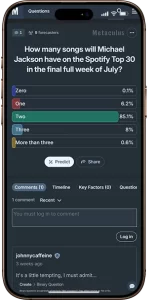
There is no native Metaculus app, and I’d say it was mainly designed to be used on desktop.
Nothing in the iOS App Store, nothing on Google Play. You get the responsive website, and I spent about two weeks working from my phone to find out whether that matters.
- For binary questions, it holds up well. The forecast slider works with a thumb, the community prediction and comment thread stack cleanly, and the reaffirm button in the feed is arguably better on mobile than on desktop. Notifications arrive by email rather than push, which I ended up preferring, since it kept forecasting from becoming a compulsive check.
- Continuous questions are where it gets awkward. Building a distribution means dragging a mode slider plus shape sliders, stacking up to five weighted components, and reading a density figure under the chart. On a laptop that is precise work. On a six-inch screen it is fiddly, and I was off by more than I intended on my first few numeric forecasts.
My verdict on UX: use mobile for monitoring, reaffirming, and reading comments. Move to a desktop for anything involving a distribution.
Markets You Can Forecast on Metaculus
One mechanical note before the categories. Each of these behaves like a market board on the surface, with a live crowd percentage and an active comment thread, but your input is a probability rather than an order.
On range questions, you submit an entire distribution, which is something no order book can represent.
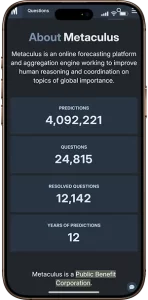
The platform carries roughly 24,000+ questions, about half already resolved, with more than four million forecasts submitted across its history. Those counters run live on the about page and keep climbing.
Artificial Intelligence and Technology
The deepest and most active category on the site, covering capability milestones, compute and chip supply, release timing, and long-horizon scenarios.
A dedicated bot benchmarking track pits automated forecasting systems against the same questions humans face, producing one of the more interesting public datasets on machine versus human calibration.
Many AI questions use multiple choice or conditional pairs rather than plain binaries, which suits a category where the real uncertainty is about sequencing rather than occurrence.
Geopolitics and Conflict
Escalation scenarios, treaty outcomes, leadership transitions, sanctions. This category exposes a structural advantage over regulated exchanges: under CFTC rules, US designated contract markets cannot list contracts referencing war, terrorism, or assassination.
Metaculus faces no such constraint, because nobody is trading, so if you want a moderated crowd probability on a military escalation, this is one of very few places to find one. Question guidelines do prohibit predicting the mortality of specific individuals, which keeps the board from getting grim.
Economy and Business
Inflation prints, central bank decisions, jobless claims, GDP releases, commodity levels. These are usually numeric or discrete ranges rather than binaries, which is where Metaculus offers something that economy prediction markets on Kalshi and Polymarket structurally cannot.
Instead of a ladder of yes/no strikes, you submit one continuous distribution and get scored on the density you assigned to the actual print.
With an economics background, this is the category I find most useful, because it forces you to own the whole shape of your uncertainty instead of picking a threshold and hiding behind it.
Politics and Elections
Election cycles, legislative outcomes, appointments, and executive actions, plus recurring election-cycle tournaments. My read: the community forecast here is well calibrated but slower to move than a money market during breaking news.
Nobody has capital at risk forcing an instant reprice. On stable questions, that gap is irrelevant. On a fast-moving night it is not, and I would still watch a real political prediction market for live moves.
Health and Biosecurity
Disease surveillance, outbreak trajectories, drug and vaccine approvals, public health policy. A core focus area with active collaborations on respiratory disease forecasting, and the category where the community built its early reputation.
Science, Space, and Climate
Launch schedules, mission outcomes, research milestones, fusion benchmarks, and the kind of long-range climate prediction markets no real-money venue will list, because nobody wants capital locked up until 2050.
Note that questions support out-of-bounds resolution, so a result can land above or below the stated range if you assigned probability mass out there.
Question formats you will meet across every category:
| Format | What you submit | Most common in |
|---|---|---|
| Binary | One probability, capped at 0.1% to 99.9% | Politics, geopolitics |
| Numeric range | A distribution, up to 5 weighted components | Economic data, climate |
| Discrete range | A distribution over whole numbers | Counts and tallies |
| Date range | A distribution over timing | Space, science, tech |
| Multiple choice | Probabilities summing to 100% | Scenario questions |
| Question group | Independent subquestions on one page | Time-laddered questions |
| Conditional pair | Two conditionals off a parent question | Policy and AI |
Metaculus Trading Features & Tools
The toolset is built around measurement rather than execution, which makes sense when there is nothing to execute.
The Community Prediction
The headline output, and a recency-weighted median of each user’s most recent forecast, designed to resist outliers while still responding to genuine shifts in opinion.
Roughly the square root of the existing forecaster count needs to move before the aggregate does, which is why it feels sticky on popular questions. On many tournament questions it stays hidden for an initial period so nobody can simply copy it and coast.
Scoring and Calibration Tracking
Everything builds on the log score, rescaled into two readable metrics.
| Metric | Compares you to | Best possible | Typical score |
|---|---|---|---|
| Baseline (binary) | A 50/50 chance baseline | +99.9 | +17 |
| Baseline (continuous) | A flat distribution | +183 | +14 |
| Peer (binary) | Everyone else on that question | +691 | +2 |
| Peer (continuous) | Everyone else on that question | +408 | +3 |
Baseline asks “did you beat a coin flip,” peer asks “did you beat the room.” Peer scores sum to zero across all participants by design, so positive means you outperformed. Full formulas live in the scores FAQ.
The calibration curve is the feature nobody advertises, and everybody needs. Mine showed my 80% forecasts were resolving yes closer to 65% of the time, a persistent overconfidence band I had carried for years without knowing. No money platform will ever tell you that, because a P&L blends skill, luck, and position sizing into one number that cannot separate them.
Standard Features Worth Mentioning
- Key factors. Commenters log the variables driving a forecast, and others vote on impact, turning comment sections into structured research notes rather than chatter.
- NewsMatch. Surfaces relevant articles against each question using a matching model, with votes to improve it over time.
- Auto-withdrawal. Pulls your forecast after a set share of the question’s lifetime, 10% by default, with an email warning first.
- Aggregation Explorer. Exposes alternative aggregation methods on resolved questions, a genuine research tool rather than a novelty.
- API and bot tooling. An open-source ecosystem supports the automated tournaments, though the API documentation was still described as in progress when I checked.
Metaculus Forecasting Strategies & Tips
Three tips that apply specifically to how this platform scores you.
1. Forecast every question in a tournament, and forecast early
Prize share is proportional to the sum of your peer scores, squared. The squaring is the whole story. A large positive total is rewarded disproportionately; questions you skip contribute exactly zero rather than staying neutral, and your score reads zero for any period before your first forecast.
In my first tournament, I cherry-picked twelve questions I felt strongest on out of a field of forty. I was right on most of them and finished well outside the money. Coverage was the entire difference. Enter early, forecast broadly, refine later.
2. Stop extremizing, because the scoring punishes it asymmetrically
This is the most expensive habit carried over from money markets, where a 97-cent contract can still be a fine trade. Under a proper scoring rule, overconfidence is strictly bad on average.
| Your forecast | If correct | If wrong | Expected score when truth is 80% |
|---|---|---|---|
| 70% | +48 | -74 | +24 |
| 80% | +68 | -132 | +28 |
| 90% | +85 | -232 | +21 |
| 99% | +99 | -564 | -34 |
Moving from 99% to 99.9% earns a rounding error when you are right and costs a fortune when you are wrong. Your best expected outcome comes from stating exactly what you believe, which is why forecasts are capped at 0.1% and 99.9% in the first place.
3. Sweep your standing forecasts every week
Scores are time-averaged, so a forecast you set six months ago and forgot is silently earning or bleeding score every second it stands.
I block twenty minutes on Sunday evenings to reaffirm what I still believe, update what news has moved, and withdraw from anything I no longer have a view on.
Withdrawing stops score accrual without erasing what you already earned, which makes it a risk management tool rather than an admission of defeat.
Do Deposits & Withdrawals at Metaculus Apply?
There is no deposit function anywhere on the platform and no cashier page to review. Money only moves if you win.
| Direction | Method | Timing | Fees | Minimum |
|---|---|---|---|---|
| Deposit | None accepted | N/A | None | None |
| Prize payout | Cash or cash equivalent, which may include prepaid virtual cards or gift cards, at Metaculus’ discretion | Set per tournament, after winners announced | No platform fee. Recipient pays taxes | $50 threshold for tournaments ending after June 1, 2025 |
| Prize donation | Direct transfer to a listed nonprofit or regranting fund | Arranged with Metaculus | None stated | None stated |
Four things worth knowing before you count on a payout:
- You must respond to claim. Winners get emailed instructions and must return acceptance documents, identity confirmation, tax forms, and payment details. Miss the deadline or 180 days, whichever comes first, and the prize is forfeited.
- You do not choose the payment form. Metaculus decides, and no alternative is offered. You might receive a virtual card rather than a bank transfer.
- Below-threshold prizes vanish upward, redistributed to higher-ranked forecasters.
- You can donate instead. A published option routes winnings to nonprofits if you would rather skip the tax paperwork.
Are there any Metaculus Fees or Costs to Consider?
Shortest section in any platform review I have written. Metaculus is free, with no catch and no premium tier.
| Cost type | Metaculus | Typical event exchange |
|---|---|---|
| Account or subscription | $0 | $0 |
| Trading commission | None. No trades exist | Per-contract taker fee |
| Bid-ask spread | None. No order book | 1 to 3 cents, wider on thin markets |
| Settlement fee | None | Sometimes charged on winnings |
| Withdrawal fee | None | $0 to a few dollars |
| Tax on winnings | Paid by recipient | Paid by recipient |
The cost is your time. A competitive tournament run means research across thirty-plus questions and regular updating over months. What you buy with it is a scored, public track record, which no money platform gives you at any price.
Metaculus Forecasting/Trading Limits & Liquidity
Position limits do not exist, because positions do not exist. What is constrained is the shape of what you can express:
- Binary forecasts bounded between 0.1% and 99.9%
- Continuous densities restricted to roughly 0.01 to 35, with a small uniform component added to every distribution, which stops one confident miss from producing an infinitely negative score
- Up to five weighted components for building a multi-modal distribution
- One account per person. Sharing and team play are prohibited unless a tournament explicitly allows it
- Registered bots are ineligible for human tournament prizes, though humans may use AI tools to assist their own reasoning
- New accounts wait 12 hours before commenting unlocks
Liquidity has a direct analog here, and it is forecaster count. A question with several hundred active forecasters produces a stable aggregate that barely twitches on one contrarian input. A newly launched niche question might have a dozen, and it can swing hard on a single confident newcomer.
Before I trust a community prediction as a research input, I check the forecaster count in the sidebar exactly the way I would check depth of book before sizing into a thin market. The upside of the design is that a thin question still produces an answer, where a thin order book often produces a spread so wide it tells you nothing. The downside is the one to watch: a thin Metaculus question can look authoritative when it is really the opinion of nine people.
My Metaculus Customer Support Experience
Support runs on three channels and no phone line. There is an email address for general questions plus a separate one for account closure, a public Discord for community help, and an in-platform tagging system where you flag @admins on a resolution issue or @moderators on a pending submission.
The FAQ, scores FAQ, and medals FAQ are unusually thorough, and I found answers to most of my questions without contacting anyone.
What caught my attention the most is that the highest-stakes support interaction happens in public. When a question resolves ambiguously or gets annulled, an admin typically explains the reasoning in the comment thread where every forecaster can read and challenge it.
I dug through several disputed resolutions and found detailed rationales rather than boilerplate.
Response times are not published, there is no live chat, and etiquette asks you not to tag admins more than once a week on a single question, so a stuck resolution can sit longer than you would like.
My verdict: For a free platform run by a small team, support is satisfactory with room to grow.
Responsible Usage Tips for Metaculus
Metaculus offers no deposit limits, loss limits, or self-exclusion tools, and needs none, because there is no mechanism to lose money. That absence is the strongest responsible-participation feature any platform in this category has, and it is why I recommend Metaculus as a first stop for anyone curious about prediction markets but unsure they can handle real stakes.
The risks that do exist are about time and psychology. Forecasting can turn into compulsive news-refreshing, and long-horizon questions can pull you into bleak subject matter for hours. Useful guardrails already exist, even if they are not framed as safety features:
- Auto-withdrawal removes the pressure to babysit stale forecasts
- Notification settings can be dialed back so the platform stops pinging you
- The community prediction can be hidden if watching it triggers second-guessing
- Account closure is available on request with data removal
Mine are simple. Forecast on a schedule rather than on impulse, cap yourself at one or two active tournaments so coverage stays realistic, and remember that a bad peer score across twenty questions is noise rather than a verdict. Community forecasts are wrong regularly, and treating any probability as a certainty is how people get hurt on the venues where money is actually involved.
Metaculus vs Other Prediction Markets
| Factor | Metaculus | Kalshi | Polymarket | Manifold |
|---|---|---|---|---|
| Money at risk | None | Real money | Real money | Play currency |
| Regulation | N/A | CFTC designated contract market | CFTC-regulated US arm plus offshore | N/A |
| Input format | Probabilities and distributions | Yes/no contracts | Yes/no contracts | Yes/no shares |
| Question creation | Moderated, admin reviewed | Exchange listed | Exchange listed | Open to anyone |
| War and conflict markets | Permitted | Restricted by CFTC rule | Restricted on US arm | Permitted |
| Payout source | Sponsor prize pools | Trading profit | Trading profit | None |
| Best for | Calibration and research | US traders wanting depth | Crypto-native traders | Casual experimentation |
Metaculus vs Kalshi
Kalshi holds a CFTC Designated Contract Market license, the same category the agency issues to major futures exchanges, and it is the deepest regulated venue available to US traders. If your goal is converting a view into dollars, Kalshi wins by default, because Metaculus offers no path to that at all.
What Metaculus gives you instead is a scored public track record and continuous distributions on economic data rather than a ladder of threshold contracts. I use both: Metaculus to build and pressure-test an estimate, Kalshi when I want to act on one. Kalshi also faces periodic state-level legal challenges affecting availability, a variable Metaculus users never have to think about.
- Recommended: See other sites and apps like Kalshi.
Metaculus vs Polymarket
Polymarket runs a large offshore exchange settling in USDC alongside a CFTC-regulated US platform. It is fast, liquid on headline events, and crypto-native. Metaculus is slower to reprice on breaking news and pays only through tournaments.
The real trade-off is question horizon. Polymarket’s incentives push toward short-dated, high-volume markets, because that is what generates trading revenue. Metaculus can host a question resolving in 2050 and still attract thoughtful forecasts, because reputation compounds over years and nobody needs an exit. For anything beyond a quarter out, I trust the Metaculus community forecast more. For anything resolving Tuesday, I look at Polymarket.
- Recommended: Learn more about Polymarket alternatives.
Metaculus vs Manifold Markets
The closest comparison in spirit, since neither requires real money, but the philosophies diverge sharply. Manifold uses play currency and lets anyone create a market on anything, producing enormous variety, a fun social feel, and wildly uneven resolution quality.
Metaculus reviews questions through moderators before they go live, meaning fewer questions but far cleaner resolution criteria and an accuracy record you can actually cite.
Manifold is the better sandbox for learning market mechanics. Metaculus is the better gym if you want a credential and measurable calibration improvement. Good Judgment Open sits closer to Metaculus in approach, though with a narrower question set. Beginners often benefit from a month on each.
My Final Words on Metaculus
Metaculus solves a problem most platforms in this space do not attempt: telling you whether you are actually any good at this.
The scoring is proper, the calibration feedback is specific, question quality is the best in the category, and the whole thing costs nothing but attention. The limitations deserve equal weight.
There is no bonus and no realistic income path for most users, the community forecast lags money markets on breaking news, continuous questions are frustrating on a phone, and support is documentation-first.
My recommendation is that if you are a beginner, open a Metaculus account before you open a funded one anywhere else. Spend six months learning how implied probability, base rates, and resolution criteria really work without risking a dollar.
You come out with a public track record and a calibration curve, worth more than the couple hundred dollars you would have lost learning the same lessons the expensive way.
If you are an experienced trader, treat this as a research and calibration layer rather than a destination. Build your estimates here, then take them somewhere you can act on them, whether that is a regulated venue like Kalshi or a crypto-funded one like Pariflow. Check current tournament terms before committing a season to one, because the prize structure has changed before and will again.
That is the advice I would give at this point, and roughly what I wish someone had told me when I started, when PredictIt and Augur were the only games in town.
Metaculus Forecasting FAQs
Completely. No subscription, no premium tier, no deposit, no fees of any kind. The platform is funded through partnerships and private forecasting services sold to organizations, not by charging the people who forecast.
No, and there is nothing for one to apply to. Metaculus does not accept deposits, so there is no bonus, match, or referral offer. The only money available comes from sponsor-funded tournament prize pools awarded on accuracy.
Yes, but only a small minority do. Prizes go to top tournament performers through an algorithm based on peer scores squared, and tournaments ending after June 1, 2025 pay nothing below $50. The stronger long-term path is the Pro Forecaster program, which recruits from the top of the leaderboards and requires at least 75 resolved questions plus a year of history.
The community prediction has a strong published track record, particularly on long-horizon questions, and Metaculus maintains a public track record page rather than asking you to take its word. The aggregate typically outperforms most individual forecasters on the platform, which is why its peer score runs positive.
It looks like one and gets used like one, but there is no trading, and Metaculus says as much in its own FAQ. Prediction markets set prices through buying and selling. Metaculus asks directly for a probability and aggregates the answers into a weighted median, which is exactly why it holds up on long-horizon questions where no trader wants capital tied up for a decade. Treat it as a sibling of Good Judgment Open rather than a competitor to Kalshi.
Forecasting carries no guarantees. Community forecasts are wrong regularly, and nothing in this review is financial advice. Metaculus involves no financial risk by design, but platform features, tournament terms, prize rules, scoring methods, and prize eligibility can change at any time and differ by jurisdiction. Always verify current terms on the platform before committing time to a tournament.
